
Laminate · Color and design
How to Choose Realistic Wood-Look Laminate: Grain, Texture, Plank Size, and Pattern Repeat
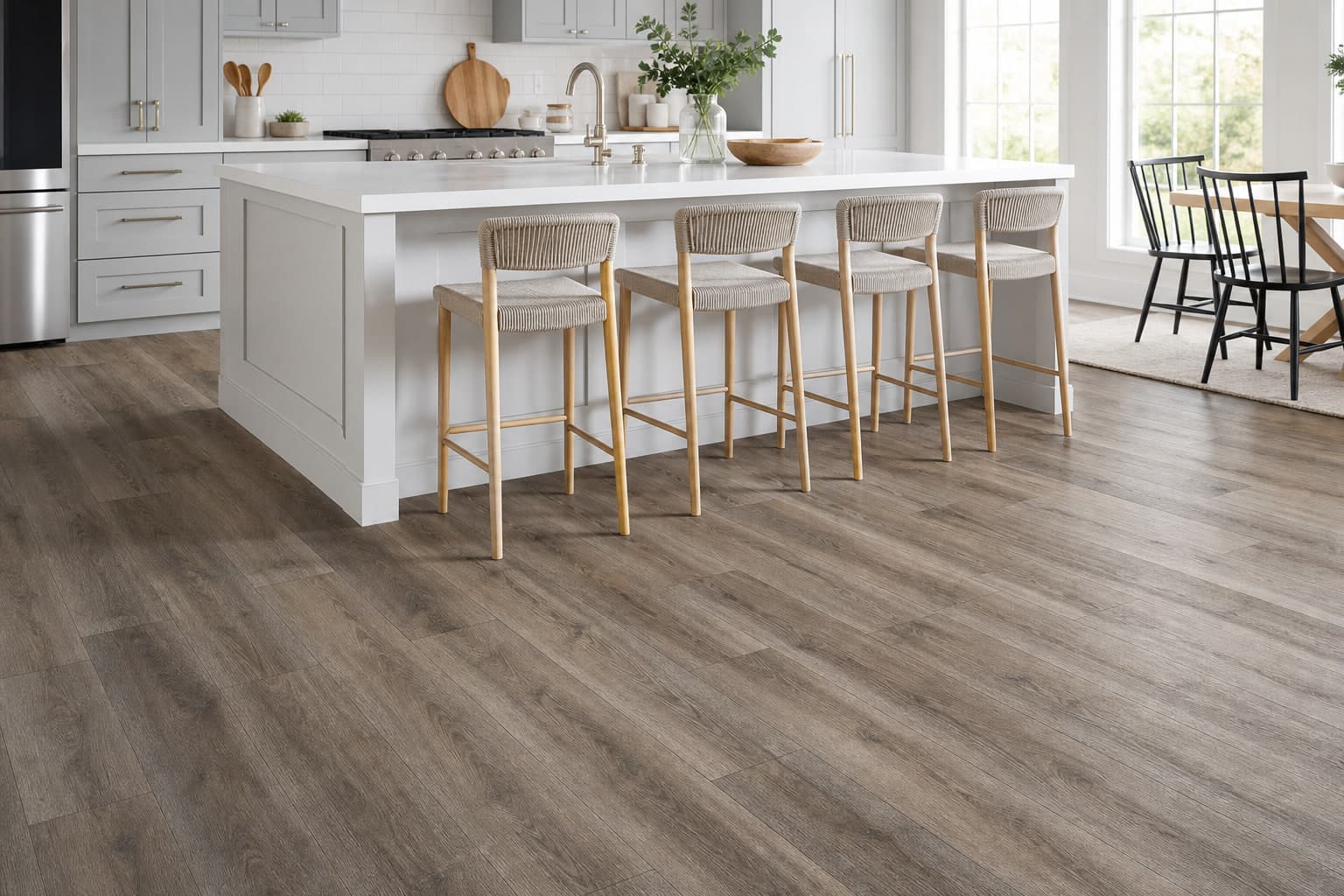
A believable wood-look laminate does not depend on a single dramatic knot. The most convincing floors coordinate print quality, texture, finish, board proportions, edge detail, and enough visual variety to feel natural across the entire room.
The short answer
Choose wood-look laminate by viewing several full planks together, not by approving one small chip. Look for grain that is the right scale for the plank, texture that supports the printed details, a sheen that behaves naturally in your light, believable bevels, and enough unique board images that distinctive knots do not repeat in an obvious grid. Then confirm that the product's performance and care specifications fit the room; realism alone is not a suitability rating.
What matters most
- Pattern repeat is easiest to judge with multiple full planks or a large installed-room image.
- Embossed-in-register means the surface texture is designed to align with the printed grain; ordinary embossing may not align exactly.
- Plank width changes visual scale, but the room dimensions and actual board length matter too.
- Low sheen often reads more like unfinished or matte wood and shows fewer reflections, while the right choice still depends on the intended look.
- Color variation, bevels, and texture can improve realism only when they work together rather than competing for attention.
Think beyond the sample
Judge the repeated floor, not the prettiest board
Laminate gets its wood appearance from a printed design. A collection can contain multiple plank images, and those images repeat as the floor grows. Repetition is not a defect—it is part of printed flooring—but distinctive knots, splits, or dark patches become noticeable when identical boards land close together or in the same orientation.
Ask how many unique visuals are in the collection, then view as many as practical. Some manufacturers publish that number for each style; others provide room scenes or display boards. During installation, opening and blending from multiple cartons can help distribute color and repeated features, subject to the maker's instructions. The goal is not random perfection, but a layout without obvious clusters.
A simple showroom test
Photograph several full boards together, then look at the photo from across the room. If one dark knot repeats immediately, ask how many unique visuals the product has and how the installer will blend cartons and orientations.
Use your eyes and hands
Understand what texture contributes
Embossing adds raised and recessed detail to the surface. When the texture follows the printed grain—often called embossed-in-register—the pore lines, knots, or saw marks can feel more connected to what you see. A general texture can still look good, especially from normal standing height, but close side light may reveal that it does not line up with the image.
More texture is not automatically more realistic. Deep, uniform ridges can feel artificial or collect residue if the care routine is poor. Compare the surface under both direct and side light, run a clean microfiber cloth across it, and decide whether the relief supports the species and finish being represented. A smooth maple look and a reclaimed-oak look should not need the same surface treatment.
| Detail | What to inspect | Possible tradeoff |
|---|---|---|
| Printed grain | Scale, sharpness, color depth, and whether knots look photographic | Very dramatic boards can make repetition easier to spot |
| Embossed texture | Whether relief supports or aligns with the printed grain | Deeper texture can change sheen and cleaning feel |
| Beveled edge | Depth, color, and whether the seam resembles a real board edge | A dark or deep bevel emphasizes every plank and joint |
| Sheen | Reflections in daylight and lamps | Higher sheen can show dust, smudges, or flat printed areas more readily |
| Color variation | Change within each board and from board to board | Strong variation needs careful blending and a larger sample |
Fit the room
Match plank proportions and grain scale to the space
Wide visuals can make an open room feel calmer because there are fewer long seams, while narrower boards can add rhythm and traditional detail. Neither rule is universal. A wide plank with oversized grain may dominate a narrow hall, and a very narrow visual may make a large open area feel busy. Actual plank width and length—not the marketing name—are what affect the layout.
Doorways, islands, hall turns, and sight lines matter as much as square footage. Lay sample boards in the intended direction and look from the main entrance to the room. If the floor continues through several spaces, use a scaled plan to see where end joints, transitions, and directional changes may fall before treating the color decision as finished.
Small or narrow room
Check whether a broad grain and deep bevel crowd the space; do not assume wide boards automatically make it larger.
Open plan
Look for enough pattern variety and a grain scale that remains believable across a long sight line.
Connected hall
Consider how board direction and transitions affect the view into adjoining rooms.
Busy furnishings
A quieter, lower-contrast floor can support patterned fabrics, colorful cabinets, or prominent stone without competing.
Bring the sample home
Check undertone and contrast in the room's real light
A floor that looks neutral under showroom lights may read gray, pink, yellow, or green beside your cabinets and walls. View the sample during the morning, afternoon, and evening. Stand it both flat and upright: a horizontal surface reflects light differently from a vertical sample board.
Instead of forcing an exact color match, look for a compatible undertone and intentional contrast. A near-match between cabinets and flooring can appear accidental if their undertones disagree. Bringing paint chips, a cabinet door, a countertop sample, and photos of fixed materials makes the comparison much more reliable.
Warm woods
Compare red, orange, and yellow undertones against cabinetry rather than relying on labels such as natural or honey.
Gray and taupe
Check for blue, green, violet, or brown undertones beside the wall and stone surfaces.
Very light floors
Inspect printed contrast and bevel color; dark seams can make an otherwise airy floor read busier.
Very dark floors
Test how dust, pet hair, footprints, and window reflections look on the sample.
Narrow the shortlist
Separate design approval from technical approval
Once two or three styles look right, review the product sheets as a separate step. Confirm the intended room, documented use level, water terms, surface-care rules, attached pad or underlayment requirement, overall thickness, finished height, transition pieces, stair parts if needed, and warranty. A beautiful board that is not approved for the room is not a finalist.
For the final visual check, view full boards from normal standing distance, photograph them in the room, and compare large installed images when available. Save the exact manufacturer, collection, color, and item number. Similar color names can refer to entirely different constructions and performance systems.
| Pass | Questions to answer | Evidence to collect |
|---|---|---|
| Design | Does the grain, texture, scale, color, sheen, and repetition look convincing here? | Several full boards, home photos, room light, and a large installed view |
| Technical | Is the exact floor approved for this room and expected use? | Specification, installation guide, care guide, and warranty for the item number |
Plain-language answers
Common questions
What does embossed-in-register laminate mean?
It describes surface texture designed to line up with printed features such as grain and knots. It can improve realism, but print quality, sheen, bevels, plank variety, and the room's lighting still affect the finished look.
How many unique plank images should laminate have?
There is no universal minimum. More unique visuals can reduce obvious repetition, especially in a large open area, but a quiet pattern can repeat less noticeably than a dramatic one. Ask for the product's stated repeat or unique-plank information and view several boards.
Does wide-plank laminate make a small room look bigger?
It can create a calmer rhythm, but the result depends on board length, grain scale, color contrast, direction, cuts, furniture, and the room's shape. Lay out full-size samples rather than relying on the width label alone.
Should laminate match the kitchen cabinets?
It usually needs to coordinate, not duplicate them. An intentional light-dark contrast or compatible undertone is often easier to read than two woods that almost match but have conflicting color or grain.
Checked, not guessed
Sources and technical review
Reviewed on September 11, 2026 by Floors Now! flooring team, Connecticut flooring sales and installation team. The sources below support the general guidance. The instructions, room approvals, cleaner list, installation guide, and warranty for the exact product you buy always take priority.
- Mannington: Restoration Collection Laminate
Shows how one current laminate collection documents wood-look styling, water claims, room recommendations, certifications, and product-specific resources.
- North American Laminate Flooring Association (NALFA): Product Certification Standards
Explains the LF-01 performance categories and the range of properties considered in NALFA product certification.
- Shaw Floors: Laminate Flooring Installation
Shows a current manufacturer example of product-specific preparation, underlayment, movement space, fixed-object, and installation requirements.
Keep planning
Laminate Product Guide
Compare wood looks with water, wear, joint, and installation considerations.
productBrowse Laminate Styles
See current products and save the exact colors you want to compare.
articlePlan Laminate Through Multiple Rooms
Work through direction, transitions, expansion, and visual flow.
projectCompleted Flooring Projects
See how floor color, scale, and layout read in finished Connecticut spaces.
serviceVisit or Contact Floors Now!
Bring room photos and compare full-size samples with the Newington team.