01
What does the surface resist?
Abrasion, scratches, impact, stains, and water are different challenges. An AC rating helps describe abrasion performance; it cannot answer every durability question.
Newington showroom • Serving Connecticut

Laminate product guide
Look beyond the wood grain. Compare water protection, surface wear, attached pad, locking joints, and the preparation that makes the floor work in your home.
Request a free laminate estimate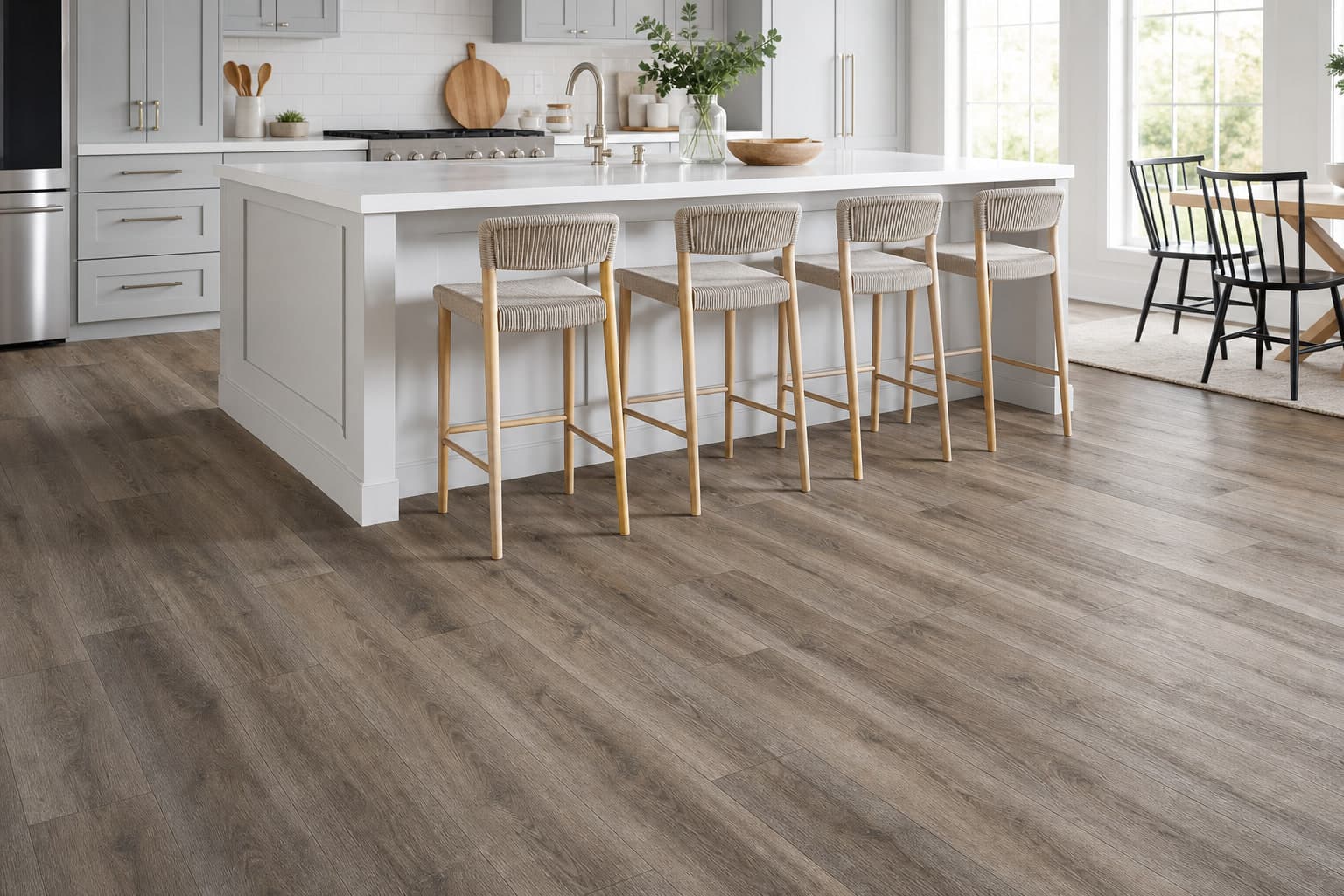
Laminate combines a decorative image with a hard protective surface and a wood-based core. It can offer convincing wood visuals and useful wear performance, but products differ considerably. A good choice fits the household, the room's moisture conditions, and the complete floating-floor system beneath your feet.
01
Abrasion, scratches, impact, stains, and water are different challenges. An AC rating helps describe abrasion performance; it cannot answer every durability question.
02
Look beyond the word waterproof. Check the approved rooms, joints, perimeter details, exposure limits, and whether the promise covers only the flooring or other parts of the installation.
03
Flatness, moisture testing, the correct pad or vapor layer, locked joints, and room to move all matter. Attached padding makes one step convenient; it does not replace preparation.
Understand the layers
Most laminate uses a high-density fiberboard core beneath its decorative image and protective surface. The image can resemble wood or stone, but the face is different from the real-wood veneer on engineered hardwood.
A printed surface over a wood-fiber core
Scroll across the table to compare every column.
| Description | What it describes | Useful strengths | Tradeoffs | What to verify |
|---|---|---|---|---|
| Conventional laminate | Typically combines a protective overlay, printed design, wood-fiber core, and balancing backing. This comparison describes products without a separately documented enhanced water-protection system, not a formal quality grade. | Can offer an appealing printed wood or stone look and suitable surface-wear performance for an approved interior room at a competitive installed price. | Moisture reaching vulnerable joints or core material can cause distortion. A durable surface does not establish protection against prolonged spills or moisture beneath the floor. | Check room approval, cleanup instructions, surface testing, installation requirements, and the actual water exclusions instead of assuming all conventional products behave alike. |
| Water-resistant laminate | Laminate marketed with defined protection against certain water exposures. Improved edges, joints, core treatments, or other features may contribute; the term does not establish one universal construction or exposure duration. | May provide useful protection from ordinary household accidents when the product, room, installation, and prompt cleanup match the written requirements. | Coverage may be limited by the water source, exposure conditions, or affected component. Products using the same marketing term can offer substantially different protection. | Read the permitted exposure, joint and perimeter requirements, approved rooms, and remedy. Compare those details with products labeled waterproof rather than relying on the word alone. |
| Laminate marketed as waterproof | A product-specific claim that may combine a protected surface, water-resistant or watertight joints, treated edges, and required installation details. These products can still contain a wood-fiber core. | Can broaden the choice of laminate for spill-prone households and expressly approved kitchens, bathrooms, or below-grade spaces. | The claim does not waterproof an entire room or automatically cover every flood, leak, wet-cleaning method, or moisture source. The marketing groups here can overlap rather than form standardized grades. | Confirm whether coverage includes the planks, joints, subfloor, or labor, and how cut edges, penetrations, and perimeter sealing must be handled without restricting movement. |
These descriptions help organize the comparison; they are not three universal industry grades. The same HDF-based construction can appear in different water-protection systems. Improvements to the surface, edges, core treatment, locking joints, and installation details can change performance significantly. Read the exact specifications and warranty rather than assuming that all wood-fiber products behave alike.
The protective surface is designed to keep the image looking good through normal use. Once that image or core is damaged, laminate cannot be sanded and refinished like suitable hardwood. Local touch-up or plank replacement may be possible, so appearance, durability, repair access, and spare material belong in the original buying decision.
Further reading: NALFA explanation of laminate construction.
Similar looks, different materials
A wood-look plank does not identify what is inside it. Compare the actual construction, approved room, surface performance, feel, installation, and renewal options before choosing between material families.
Scroll across the table to compare every column.
| Material | Construction | Useful strengths | Tradeoffs | What to verify |
|---|---|---|---|---|
| Laminate | A printed decorative surface protected by an overlay, usually supported by a wood-fiber core and balancing layer; some products include attached pad. | Offers a wide range of visuals and surface-abrasion performance, often with floating click installation. Enhanced water systems are available for specified applications. | The printed surface cannot be renewed by sanding like real wood. Core swelling and damaged locking edges can require plank replacement. | Compare abrasion, scratch, impact, water, joint, and acoustic performance separately, alongside approved use and complete installed cost. |
| Luxury vinyl plank or tile | A vinyl-based flooring category with printed visuals and a protective surface. Flexible, rigid-core, glue-down, and floating products have different constructions. | Provides many water-resistant material options and installation methods. Certain products can suit environments or attachment requirements that rule out a particular laminate. | Scratch, dent, heat, sound, and joint performance vary. A waterproof plank does not automatically protect the entire building assembly from water. | Compare the actual core, surface, installation system, exposure limits, and room approval. Neither category is always softer, quieter, or more realistic than the other. |
| Engineered hardwood | A real wood face bonded to supporting layers of wood or wood composite. The natural surface distinguishes it from laminate's printed image. | Offers authentic wood grain and generally greater dimensional stability than comparable solid wood. Some products permit surface renewal when sufficient usable wood remains. | Natural wood can dent, scratch, and react to moisture. Refinishing potential depends on the specific face, floor condition, and manufacturer guidance. | Compare real wood thickness, finish care, installation approvals, and renewal options rather than assuming every engineered floor can be sanded. |
| Solid hardwood | Each board is a piece of wood, with its usable surface above the tongue, groove, and other structural details. | Provides natural character and potentially extensive renewal options in a suitable, controlled environment. Different species, cuts, and finishes offer distinct appearances. | Responds to moisture changes and can require a different substrate or installation approach. Dents and scratches remain possible, and the supply of sandable wood is finite. | Review site and grade-level approval, moisture conditions, finish upkeep, and full installation costs. Compare the value of natural material and repair options with your priorities. |
Vinyl-based flooring generally has a core less vulnerable to water swelling than ordinary wood-fiber laminate. That can make luxury vinyl worth comparing for a water-prone room. Modern laminate systems can also provide substantial product-specific water protection. Neither material's name proves that the subfloor, walls, cabinets, or complete room will be protected from a flood or hidden leak.
Laminate often offers a firm surface and detailed wood visuals; luxury vinyl ranges from flexible constructions to very rigid cores. Texture, sheen, printed-face variety, plank dimensions, support, and underlayment affect the experience. Avoid assuming all vinyl feels soft or all laminate looks more realistic. Compare full planks in the room and evaluate the actual products side by side.
Explore our luxury vinyl guide for flexible and rigid vinyl constructions, or the hardwood guide for solid wood, engineered wood, and refinishing considerations. A strong scratch claim, a thick plank, or a waterproof label should be compared within the context of the entire product.
Read the promise and the conditions
Water protection varies significantly across laminate products. The useful question is what the named flooring system is designed and warranted to handle, in the specific room, after the required installation details are completed.
Scroll across the table to compare every column.
| Water path | Why it matters | What to establish |
|---|---|---|
| Ordinary spills on the surface | The protected face and assembled joints may provide a defined level of topical-water resistance. | Approved liquids, cleanup guidance, any exposure-time limits, joint protection, and the exact warranty conditions. |
| Perimeters and field-cut edges | Liquid can bypass the protected face and reach the core or materials below at the edge of the floor. | Required flexible perimeter treatment, doorway and pipe details, cut-edge protection, and preserved expansion space. |
| Open or damaged joints | An incomplete lock, chipped edge, or stressed connection can create a water path. | Inspection, correct assembly, adequate substrate support, and a repair plan for damaged pieces. |
| Moisture from the substrate | A damp slab, wood subfloor, or crawlspace can expose the flooring from below. | Product-specific testing, moisture limits, approved vapor control, and correction of the underlying source. |
| Hidden leaks, standing water, or flooding | Water can reach the floor from directions or in quantities beyond ordinary surface-spill protection. | Explicit coverage and exclusions, the water source, access for inspection and drying, and protection of the surrounding building. |
Some laminate systems combine a protected surface, enhanced joints, edge treatment, and specific installation details. Certain warranties also address qualifying damage to the subfloor from covered surface water. That broader coverage is meaningful, but it belongs to the named product and written terms. Do not assume every waterproof laminate offers the same protection or that every source of water is included.
Some water claims depend on specified edge accessories and perimeter details as well as the plank. Include those requirements and their cost when comparing products; a sealed edge must still be compatible with the floating system.
A waterproof product may be approved for selected kitchens, bathrooms, laundry rooms, or basements when its conditions are met. Bathroom approval does not imply permission inside a shower or wet room, and below-grade approval does not eliminate slab-moisture requirements. Verify the exact location rather than extending one approved application to every place that can get wet.
A waterproof label does not establish coverage for unlimited standing water, every appliance leak, or flooding. Products differ in permitted exposure, affected components, and owner obligations. Compare the written warranty with the water risks of the actual room.
Further reading: Pergo example of a system with surface and subfloor water coverage.
Further reading: Mannington product-specific water coverage and requirements.
Abrasion is one kind of durability
AC means abrasion class. It helps compare how a laminate surface resists wearing through in the applicable standardized test. It does not independently rate scratch resistance, dent resistance, waterproofing, locking strength, or the quality of the complete installation.
Scroll across the table to compare every column.
| AC designation | How to read it | What it does not decide |
|---|---|---|
| AC1 and AC2 | Lower abrasion classes. If encountered, check the actual intended residential use and warranty carefully. | A class alone is not a room approval, lifespan estimate, or a guarantee about the floor's response to spills and impacts. |
| AC3 | A surface-wear level found in products intended for residential use and other expressly declared applications. | Suitability for a busy household still depends on the complete product, traffic conditions, grit, care, and stated use. |
| AC4 | A higher abrasion class often found in products for active homes and certain commercial applications. | It does not automatically establish one commercial use class, immunity to pet scratches, or a particular water warranty. |
| AC5 and AC6 | Higher abrasion classes intended to provide more resistance in the relevant surface-wear test. | The highest number is not automatically the best overall choice for every home. Confirm comfort, water protection, joints, application, and warranty too. |
AC and use class are related but different. A declared use classification evaluates suitability using the applicable set of product requirements. It should not be inferred from the abrasion number alone. If a commercial application is involved, ask for the written use classification and commercial warranty, including the type of traffic and loads allowed.
Repeated surface wear is different from a sharp grit particle, a dragged chair, or a pet claw marking the finish. A high AC rating does not make laminate scratch-proof. Ask for the actual scratch or scuff claims and their test context, and compare them with the household's expected use.
A firm laminate surface can perform well under everyday use, but dropped objects, concentrated furniture loads, and vulnerable edges can still cause damage. Stain and fade performance are also separate characteristics. Compare the manufacturer's relevant claims, load guidance, and exclusions instead of using AC as a substitute for all of them.
Further reading: NALFA performance testing and certification categories.
Keep the product sheet beside the sample
Two floors with similar dimensions or wood visuals can have different joints, pads, water coverage, approved rooms, and maintenance rules. Build the shortlist from the complete written product information.
Scroll across the table to compare every column.
| Specification | What it means | How to compare it |
|---|---|---|
| AC abrasion rating | Describes resistance to abrasive surface wear under a defined test, rather than rating the entire floor. | A higher class indicates greater abrasion resistance within the relevant system. It does not automatically improve scratch, impact, water, or locking-joint performance, and it does not establish the warranty. |
| Use class and warranty eligibility | The manufacturer's intended application and any broader performance classification, separately from the AC number. | Check residential, rental, office, and commercial eligibility for the actual use. Do not assume a rigid AC-to-room mapping or that a commercially described product has unlimited commercial coverage. |
| Plank thickness versus total thickness | The stated dimension may describe the board alone or include an attached pad. | Ask for both measurements when comparing floors and planning doors, appliances, stairs, and transitions. Extra thickness is not proof of better water resistance, a higher AC rating, stronger locks, or greater scratch resistance. |
| Core and locking profile | The structural core supports the plank and its machined connections; the joint design controls how pieces engage. | Review documented performance and installation instructions. A core label or a quick assembly demonstration cannot replace checking joint strength, support requirements, moisture protection, and the condition of delivered edges. |
| Scratch, impact, and stain performance | Separate surface or product characteristics addressing different forms of damage and household exposure. | Match evidence to the concern: grit and repeated traffic, a dropped object, claw marks, or a spill are not identical tests. Surface texture and sheen can change damage visibility without preventing damage. |
| Water system and written coverage | The documented protection provided by the surface, edges, joints, core, and required installation details. | Compare approved rooms, exposure limits, cleanup duties, exclusions, and whether subfloor or labor coverage applies. Protection from water above the floor does not waive moisture requirements beneath it. |
| Attached pad | A factory-bonded backing intended to contribute to the specified support, sound, or comfort of the flooring system. | Confirm pad type, included thickness, and any documented vapor protection. It does not flatten the substrate, strengthen damaged panels, raise surface wear performance, or automatically satisfy a condominium sound requirement. |
| Separate underlayment and vapor control | Additional materials may supply approved cushioning, acoustic performance, or moisture-vapor protection, sometimes in a combined product. | Choose only what the exact flooring permits. A second cushioning layer may be prohibited or restricted; a required vapor-control layer is a separate question from whether extra padding is allowed. |
| Plank width and length | Board dimensions affect visual scale, the number of joints, cutting, and layout through connected rooms. | Compare actual dimensions, mixed-length content, and end-joint staggering requirements. Wider or longer boards are design choices, not universal quality upgrades, and they still need consistent support from a sufficiently flat substrate. |
| Texture, EIR, sheen, and bevels | Embossed-in-register texture aligns surface relief with the printed design. Sheen and edge treatments further shape the appearance. | Inspect full boards in home lighting and feel the texture. EIR can improve visual realism but does not establish durability or water protection. Bevel appearance and protective edge treatment are separate considerations. |
| Printed faces and color variation | The range of images and shades available within a collection, including repeated grain or stone patterns. | Review several boards rather than one small sample. Plan blending and avoid conspicuous neighboring repeats while following directional instructions; additional printed faces do not eliminate the need for thoughtful layout. |
| Emissions documentation | Product-specific test reports, compliance labels, or certifications describe particular emissions criteria and testing scopes. | Identify what was tested and whether it applies to the exact flooring and any added materials. Low-emission certification, formaldehyde compliance, scratch performance, and water performance answer different questions; no single label measures every feature. |
Save the exact collection, style, color, size, product code, and specification version with your quote. A feature shown on a brand's general website may apply to only part of its range. If an important detail is absent from the sheet, get it clarified before ordering rather than substituting an assumption from a similar-looking product.
Choose the whole visual range
A small sample can show color but miss the variation that defines a finished room. Compare the lightest and darkest boards, knots, grain, texture, printed-face repeats, and edges under your own lighting.
Embossing gives the surface physical texture. Embossed-in-register, often abbreviated EIR, aligns that texture with features in the printed image, such as grain or knots. It can add realism, but it is an appearance feature rather than a water or wear rating. Compare a full plank by sight and touch, including how easily its texture can be cleaned.
Sheen changes how the floor reflects windows and room lighting. Low-sheen surfaces can look understated; stronger reflections may make marks, dust, and surface changes more noticeable in some rooms. Texture can also hold soil. Choose the actual finish with your lighting and cleaning habits in mind instead of assuming every matte floor hides damage or every smooth floor is easy to maintain.
Laminate uses a finite set of decorative images or print variations. The number and prominence of repeated knots or grain features affect realism across a large room. Review multiple cartons or representative room images, then plan how boards will be distributed. Mixing the permitted variation helps avoid obvious repeats; it cannot create a different color range from the one manufactured.
Square edges can create a more continuous field; beveled edges outline the individual boards. Painted or other treated bevels change the contrast and can be part of a product's water-protection design. Inspect the actual edge profile and cleaning instructions. A decorative bevel does not prove the joint is waterproof, and a wide plank does not automatically make joints less visible.
Place samples next to cabinets, paint, furniture, and adjoining flooring. View them during the day and at night, and compare warm and cool undertones over a larger area. Photographs and screens can shift color. A grain pattern that looks quiet in one plank may dominate a room when repeated, while a strongly varied collection needs acceptance of the full range.
Thickness is only one measurement
Width and length affect the visual rhythm. Thickness affects the floor build-up and details. None of those dimensions alone establishes abrasion resistance, water protection, joint quality, or a more realistic appearance.
Scroll across the table to compare every column.
| Choice | What it changes | What to verify |
|---|---|---|
| Plank thickness | Can influence handling, edge profiles, and the height of the finished assembly. | Whether the quoted number includes the attached pad. Compare the core, lock, surface, and approved underlayment separately. |
| Width and length | Changes the number of visible joints and how grain repeats across the room. | Actual dimensions, room shape, first and last row widths, and the manufacturer's substrate and layout requirements. |
| Mixed or fixed sizes | Can create different visual patterns and ordering needs. | Whether sizes are designed to combine, how the joints align, and whether spare material will match the selected format. |
| Straight plank direction | Changes sightlines through the space and between connected rooms. | Structural and installation requirements, doorways, longest runs, focal points, and any necessary transition breaks. |
| Herringbone or another specialty pattern | Adds a deliberate geometric design and usually more cutting and fitting. | A product and locking system expressly designed for the pattern, including left/right boards if used. Ordinary click planks are not interchangeable with pattern-specific products. |
| Finished floor build-up | Affects door clearance, thresholds, appliances, stair details, and adjacent materials. | The combined flooring, pad, approved layers, and substrate preparation. A thicker plank can create extra transition work even when its material price is attractive. |
The measured layout affects visible cuts, repeated prints, and the material allowance. Compare the proposed appearance and order quantity together: pattern, room shape, selection, and spare material prevent one waste percentage from fitting every project.
Use the room to narrow the shortlist
Dry bedrooms, busy kitchens, below-grade rooms, offices, and stairs pose different demands. A material can be a useful candidate without every collection being approved for every location.
Scroll across the table to compare every column.
| Room or situation | Selection direction | What to confirm |
|---|---|---|
| Bedrooms and quieter rooms | Compare the visual, underfoot feel, sound, and realistic cleaning needs. A lower-traffic room may not benefit from the highest available abrasion class. | Check furniture protection, sunlight, room conditions, and adjoining-floor height. A room used as an office can have concentrated rolling wear despite limited foot traffic. |
| Living and family rooms | Balance traffic, pets, toys, spills, and appearance rather than buying on one specification. Consider how the pattern repeats across the full room. | Review surface performance, water coverage, connected-room limits, and the locations of fixed cabinets, hearths, or large fixtures that affect the floating installation. |
| Hallways, entries, and mudrooms | Repeated walking paths, tracked grit, wet footwear, and exterior doors make both abrasion and water protection relevant. | Check the permitted exposure, edge details, door clearance, compatible mats, and maintenance. A higher AC rating does not establish resistance to water entering around the perimeter. |
| Kitchens and laundry rooms | Compare products approved for the expected spills and appliance-related conditions, with clear water-warranty terms and cleaning instructions. | Plan perimeter and penetration treatment, appliance replacement access, cabinet placement, and finished height. Water beneath appliances or flooring remains a separate concern from a visible spill on top. |
| Bathrooms | Use only a product expressly approved for this application and follow its required installation details. Bathroom approval does not authorize use inside a shower or steam room. | Confirm tub, toilet, pipe, doorway, and perimeter details, along with water exposure and maintenance limits. The floor covering does not create a waterproof room. |
| Basements and concrete slabs | Choose a product with the required grade-level approval after evaluating moisture history, slab condition, and year-round room conditions. | Document testing, vapor control, preparation, and the response to failed moisture results. Waterproof surface marketing and attached pad do not resolve groundwater, leaks, or a damp substrate. |
| Home offices and work areas | Repeated rolling, concentrated chair loads, desk feet, and equipment can create different demands from walking traffic. | Check rolling-chair approval, appropriate casters or mats, load limits, and the actual use classification. A high AC number alone does not qualify a floating system for every workstation. |
| Condos and upstairs rooms | Compare in-room walking sound and sound transmitted below as separate concerns. Both depend on the flooring and the building assembly. | Obtain the building's written requirements and relevant test documentation. Verify approved underlayment before ordering; adding an arbitrary pad can compromise joints without securing acoustic approval. |
In a generally dry bedroom, appearance and budget may lead the decision. In an entry or kitchen, tracked grit, water, appliance clearances, and cleaning become more prominent. In a basement, the slab and moisture conditions may determine suitability before a style is selected. An outdoor space, shower floor, or frequently flooded area should not be treated as an ordinary laminate application.
Bring year-round conditions into the conversation. Seasonal homes, enclosed porches, rooms with large south-facing windows, and spaces that lose normal heating or cooling may fall outside the product's permitted temperature or humidity range. A floor that looks appropriate in a room photograph can still be unsuitable for the actual environment.
Plan for the household
A busy home combines grit, spills, toys, chairs, and pet accidents. Compare scratch, impact, rolling-load, and water performance separately against the way your household uses each room.
Compare the written pet and water coverage, including the substances and conditions covered. A pet warranty may address particular staining or surface-water events without covering every scratch, odor, repeated leak, or damage below the floor.
A durable wear surface is useful for active rooms, but a dragged toy with grit underneath or a dropped hard object can damage a surface differently from foot traffic. Match the product to the household without expecting a wear class to make it immune to accidents.
Chair casters and concentrated rolling loads can stress the surface and joints. Check the approved caster type, load guidance, and any requirement for a suitable chair mat. A commercial-looking office does not by itself establish commercial approval, and a higher AC class does not replace rolling-load guidance. Do not choose extra-soft underlayment as a way to cushion repeated chair movement.
Grit brought in from outside can abrade or scratch floors, while wet footwear adds moisture exposure. Compare both surface performance and the written water limits for a frequently used entry. Door clearance and adjoining-floor height also affect the installation plan.
Read certifications by their scope
Laminate's wood-fiber core and the complete finished product can be evaluated under different requirements or certification programs. Ask what was tested, which exact product is covered, and what the result actually demonstrates.
In the United States, EPA's TSCA Title VI program addresses formaldehyde emissions from regulated composite-wood products and applicable finished goods. Look for the appropriate compliance documentation for the flooring. Compliance is not a promise of zero emissions or a measure of surface wear, waterproofing, or installation quality.
Low-emission certifications such as GREENGUARD Gold or FloorScore, where offered for the specific product, have their own test scope and criteria. Performance certifications and responsibly sourced wood claims answer different questions again. Verify the current listing and exact collection instead of assuming that one certified product makes every floor from that brand equivalent.
Include other installation materials in the discussion when indoor emissions are a priority. Underlayment, adhesives used for approved details, sealants, and preparation products have their own information. An odor impression alone does not establish a product's emissions performance.
Further reading: EPA explanation of composite-wood formaldehyde requirements.
Further reading: UL explanation of GREENGUARD emissions certification.
Support, sound, and moisture are separate jobs
A factory-attached backing can simplify one part of installation and influence walking noise and feel. Its thickness, density, compression behavior, and compatibility matter more than simply adding more cushioning.
Scroll across the table to compare every column.
| Layer or function | What it can contribute | What to verify |
|---|---|---|
| Attached pad | An integrated acoustic or comfort layer selected as part of the plank system. | Whether the stated plank thickness includes it, which substrates are allowed, and whether a separate vapor film is still required. |
| Separate approved underlayment | A compatible layer for a floor that needs it, with specified support, sound, and other properties. | The flooring manufacturer's allowed product type, thickness, compression characteristics, seam method, and installation conditions. |
| Combined pad and vapor-control product | Cushioning or acoustic properties together with documented vapor control when installed as specified. | The actual vapor performance, seam and perimeter treatment, substrate suitability, and compatibility with the laminate. |
| A second pad beneath attached padding | Only an option where the manufacturer expressly permits the exact combination. | Written approval. Too much compressible material can allow excessive movement and stress the joints; more softness is not automatically an improvement. |
| Acoustic performance | May reduce particular kinds of sound within a tested floor assembly. | Whether the result describes in-room walking noise or transmission to the room below, and whether the tested construction matches the building. |
The tapping or hollow impression heard while walking in a room is different from impact sound transmitted through a floor-ceiling assembly. Underlayment can affect both, but a single advertised acoustic number does not describe every installation. The supporting floor, ceiling, insulation, room furnishings, and workmanship also influence what occupants hear.
Where a building specifies acoustic requirements, provide the relevant test information and proposed construction for review before ordering. IIC, STC, and improvement figures describe different acoustic measures or test arrangements; do not compare unlike reports as though they were a universal pad ranking. A manufacturer label alone does not establish compliance with a particular condominium's rules.
Neither attached nor separate padding levels a poor substrate, repairs structural movement, or guarantees a silent floor. These limits matter when comparing a complete laminate system.
Further reading: Pergo example of a specifically approved additional underlayment.
Plan the work with our Laminate Installation service. Review installation scope and methods, then use the preparation checklist before installation day.
Find cleaning, protection, and help with common problems in our Laminate Care & Maintenance guide.
Compare future replacement options
A printed decorative surface cannot be refinished like real wood. Damaged cores or locks may require replacement, and a click connection does not guarantee simple access to one installed plank.
Joint design, installation access, matching material, and the condition of surrounding boards determine repair feasibility. Include a suitable spare-material allowance in the original order. If repeated sanding or changing stain color is central to the plan, compare hardwood products and their documented renewal potential.
For swelling, open joints, noises, surface damage, and replacement guidance, see Laminate Care & Maintenance.
Compare complete installed estimates
Laminate spans a wide range of products and project costs. The useful comparison includes the exact plank, required layers, preparation, fitting details, room access, and ownership expectations.
Identify the collection, color, dimensions, water coverage, pad, and required accessories. Distinguish measured room area from order quantity: cuts, pattern, sorting, and spare material affect how much is needed. Include transitions, stair parts, and molding in the comparison, and confirm availability before assuming a matching piece can be added later.
Clarify furniture handling, demolition, disposal, moisture testing, substrate repair, flattening, and any approved moisture-control work. Older layers and hidden conditions can affect the final scope. Ask how new findings will be documented and approved. A lower quote that assumes a perfect concealed substrate may not describe the same project as a more complete estimate.
Include underlayment or film, perimeter sealing where required, doorway work, appliance clearances, stair methods, transitions, baseboards, and any separate trade work. A straightforward click field can still have time-consuming finish details. Schedule room use around the whole assembly, including cure times for sealants or adhesives used in approved locations.
Consider routine care, room climate, water exposure, expected use, and the possibility of future board replacement. Laminate can be a useful value where its performance fits, but its renewal path differs from sandable hardwood. A longer warranty or higher AC number does not guarantee a fixed service life, resale premium, or the lowest total ownership cost.
Scroll across the table to compare every column.
| Coverage area | What to read | Question to ask |
|---|---|---|
| Wear, stains, fading, and manufacturing | The defined covered condition, permitted use, claim procedure, and exclusions for scratches, impacts, or ordinary appearance changes. | What event qualifies, and does the stated coverage match the way this room will be used? |
| Water protection | Covered liquids, source and duration, required installation, room approvals, cleanup obligations, and exclusions. | Does the promise cover only planks, or specified subfloor damage too? How are concealed leaks, flooding, and below-floor moisture treated? |
| Residential, rental, or commercial use | The use category, occupancy terms, traffic restrictions, transferability, and any separate commercial provisions. | Is this exact household, rental, office, or business application included in the written terms? |
| Labor and remedy | Removal, installation labor, accessories, disposal, related damage, prorating, replacement availability, and reporting deadlines. | What costs would a valid claim actually pay, and what remains the owner's responsibility? |
| Workmanship and supporting conditions | Installer responsibilities, substrate and environmental requirements, maintenance obligations, and separate workmanship terms. | Who assesses the cause, and which records establish that the complete installation met its requirements? |
Keep the invoice, carton labels, product code, warranty version, installation instructions, moisture and site records, underlayment details, layout changes, and care guide together. Product coverage and the installer's workmanship promise have their own terms. Read both before ordering and retain the information with your spare boards.
Further reading: Mannington collection-specific laminate warranty information.
Take this to the showroom
Bring room photos, rough measurements, information about the floor underneath, and the samples you like. A useful shortlist explains both the appearance and why the complete product fits the room.
Discuss your laminate projectCommon buying questions
Open a question for a quick answer, then use the written details of the actual product to confirm the right choice for your home.
It indicates resistance to abrasive surface wear under the relevant test system. More abrasion resistance may be useful for busy routes, but AC is not a complete durability score. Compare the product's use classification and warranty as well as separate scratch, impact, water, and joint performance. The highest number is not automatically the best purchase.
Not necessarily. Abrasive wear-through and an individual scratch are different damage mechanisms, and scratch performance can be evaluated separately. Surface texture and sheen also influence how noticeable a mark becomes. For an active home, compare the available scratch evidence, maintenance instructions, and warranty exclusions rather than assuming an AC number promises a scratch-proof finish.
Thickness affects the installed height and can influence the feel of a particular construction, but it does not establish surface wear, water protection, or joint quality by itself. Confirm whether the advertised figure includes attached pad. Compare the complete products over appropriate support, and account for doors, appliances, stair details, and transitions before selecting thickness.
Read the exact product warranty and installation instructions. Coverage can address specified surface-water exposures and may include different combinations of flooring, joints, subfloor, or labor. It does not automatically cover unlimited standing water, every plumbing leak, or flooding. Required sealing and prompt cleanup still matter, and moisture from below remains a separate installation concern.
Certain products approve those locations, while others do not. Bathroom installation may require specific perimeter and penetration details; basement installation also requires the correct grade-level approval and substrate moisture strategy. Check the actual product rather than the category name. A room that currently looks dry is not proof that its conditions meet the installation requirements.
Only if the manufacturer's documentation gives it that function within the approved assembly. Attached pad commonly contributes to sound and feel, while vapor control addresses moisture beneath the floor. Concrete or another substrate may still need a separate approved layer. Determine both requirements before installation; the presence of foam on the plank is not sufficient evidence.
Only when the exact flooring instructions permit the additional product. Some attached-pad floors prohibit another cushion; others allow a specific approved underlayment. Excessive softness can let planks move vertically and stress the locks. Choose the complete support and sound system first rather than stacking materials in the hope of improving comfort.
Sound depends on the plank, pad, substrate, room, installation, and floor-ceiling construction. In-room tapping and transmitted impact noise are different concerns. A well-matched underlayment may help, but cannot guarantee silence or repair unsupported planks. For a condominium, obtain the building's criteria and test data for an applicable assembly instead of relying on a quiet-floor label.
Sometimes, if the existing material is an approved, secure, sufficiently flat base within the product's requirements. Soft coverings, loose layers, prominent grout recesses, or concealed moisture can make removal or preparation necessary. Check finished height and transitions too. Floating installation avoids attachment to the substrate; it does not remove the need for reliable support underneath.
Fixed cabinetry or an island can restrict a floating floor and limit the approved layout. Confirm the exact product's suitability for the planned fixtures before buying. Our installation scope explains the required sequencing and movement details.
That depends on maximum run dimensions, room layout, environmental differences, doorway details, and the product's instructions. A continuous appearance may be possible, but should not be promised from a sample alone. Review expansion breaks and transitions as part of the measured layout, including where trim will cover clearances without clamping or fastening through the flooring.
It can suit a capable installer, but preparation and details often take more skill than connecting open-area boards. Angle, tapping, and fold-down profiles require different techniques. Damaged locks, poor support, or tight perimeter cuts can undermine the result. Review the actual instructions, tools, layout, moisture requirements, and repair options before deciding which work to handle yourself.
It can be when the product matches the household's abrasion, scratch, spill, and cleaning demands. Compare those characteristics separately. Pet-water coverage may have conditions that differ from ordinary stain coverage, and no label makes a floor immune to damage.
Laminate's printed surface cannot be sanded and refinished like hardwood. Local replacement may be possible, but the locking system, access, surrounding boards, and availability of matching material determine its practicality. Compare these limits before purchasing if future repairs are a priority.
Only within the exact product's approved heating and environmental conditions. Radiant systems require compatible flooring and underlayment, operating limits, and startup procedures. Seasonal homes need attention to conditions during vacancies as well as occupancy. Water protection does not waive temperature or humidity requirements, so confirm suitability for the actual year-round use before purchasing.
Only with a product and stair system approved for that application. Matching tread or nosing availability, edge appearance, and finished stair geometry can affect the choice. A product approved to float in a room does not automatically have an approved stair detail.
Specify the exact flooring, measured layout allowance, preparation, moisture testing, underlayment or vapor control, transitions, trim, sealing, stairs, removal, and furniture handling. Confirm residential, rental, or commercial eligibility and distinguish product replacement from labor coverage. Keep instructions, receipts, product labels, photos, and installation records. Compare the full system and exclusions rather than warranty length alone.
Your next step
Explore laminate styles, compare full planks in our Newington showroom, and discuss water exposure, household traffic, and the existing floor. A professional measure and site review turn the shortlist into a complete installation plan.
Reviewed by Floors Now
Our laminate selection material is supported by the North American Laminate Flooring Association, manufacturer specifications and care guidance, and the identified emissions resources. References appear beside the relevant sections. The room photograph is an illustration of laminate styling.
Manufacturer examples explain differences to look for; their approvals, features, installation requirements, and warranties apply to the identified products. Confirm the current documents for the exact flooring and supporting assembly before ordering. An onsite assessment and professional measure complete the project plan.
Back to topFlooring Advice
Focused answers for the questions that need more room than a buyer's guide.
Choosing a floor · 7 min read
Choose laminate for kids, pets, entries, and daily traffic by comparing real performance tests, water limits, joints, texture, care, and warranty terms.
Read the guideColor and design · 6 min read
Judge wood-look laminate beyond one sample by comparing grain scale, texture alignment, repeated boards, bevels, sheen, color movement, and room light.
Read the guideCare and maintenance · 6 min read
Learn what can scratch laminate, why abrasion ratings are not scratch guarantees, how to prevent marks, and when repair or plank replacement is realistic.
Read the guideInstallation planning · 6 min read
Plan laminate across connected rooms by checking direction, starting lines, expansion space, doorway transitions, floor height, and fixed objects.
Read the guideYour laminate project
Share your existing flooring, preferred look, household activity, and any water or sound concerns. Photos help; a finished plan is not required.