
Hardwood · Problems and repairs
Should You Repair, Refinish, or Replace Hardwood Floors?
Start by identifying whether the problem is in the finish, individual boards, or the floor system below. The least disruptive option that corrects the cause—not merely the visible symptom—is usually the right one.
The short answer
Repair is often appropriate for isolated damaged boards when compatible material and a sound surrounding floor make a localized fix possible. Recoat when the existing finish is worn or dull but still sound and compatible. Sand and refinish when widespread scratches, exposed wood, or a color change require removing the old finish and the floor has enough usable wood. Replace when damage, movement, moisture, contamination, incompatible construction, or too little remaining wear surface makes preservation impractical. Diagnose active moisture first.
What matters most
- Stop leaks and confirm that the floor and supporting layers are dry before planning cosmetic work.
- Cleaning, recoating, sanding, board repair, and replacement solve different problems.
- Engineered hardwood may or may not be sandable; the real-wood surface, prior work, flatness, and maker's guidance matter.
- A successful spot repair depends on board dimensions, construction, fastening, species, grade, color, and finishing—not color alone.
Do not treat the symptom first
Separate surface wear from board and moisture problems
Begin with what changed and when. A dull traffic path that developed gradually is different from boards that lifted after a dishwasher leak. Note the room, boundaries, recent plumbing or climate events, odor, discoloration, movement, gaps, raised edges, and whether the floor feels soft. Photograph the area and avoid flooding it with cleaner.
If moisture may still be active, correct the source and evaluate the subfloor and surrounding assembly. Sanding wet or moving wood can hide clues, remove useful material, and produce a result that changes again. A severe or unclear problem may require a qualified wood-floor inspector, restoration professional, plumber, or other specialist before a flooring decision is made.
| What you see | It may involve | Useful next step |
|---|---|---|
| Haze, residue, or uneven dullness | Cleaner buildup or finish condition | Identify prior products; test the approved cleaner; assess finish compatibility |
| Fine scratches in a traffic lane | Finish wear | Ask whether a maintenance coat is possible before bare wood is exposed |
| Deep scratches, widespread finish loss, or unwanted color | Finish and a shallow layer of wood | Measure remaining sandable material and evaluate a full refinish |
| One stained, split, burned, or broken board | Localized board damage | Check whether a compatible board can be repaired or replaced |
| Cupping, crowning, buckling, dark seams, or softness | Moisture or movement in the floor system | Stop the source and inspect the floor, subfloor, and conditions before refinishing |
| Widespread loose, thin, damaged, or mismatched flooring | System-level limits | Compare broader repair with partial or complete replacement |
Preserve sound flooring
When a board repair or weave-in can work
A localized repair makes sense when damage is limited, the surrounding boards and subfloor are sound, and compatible material can be installed without creating disproportionate damage. The installer must identify whether the floor is solid or engineered, board width and thickness, tongue-and-groove profile, species, cut, grade, fastening, direction, and finish.
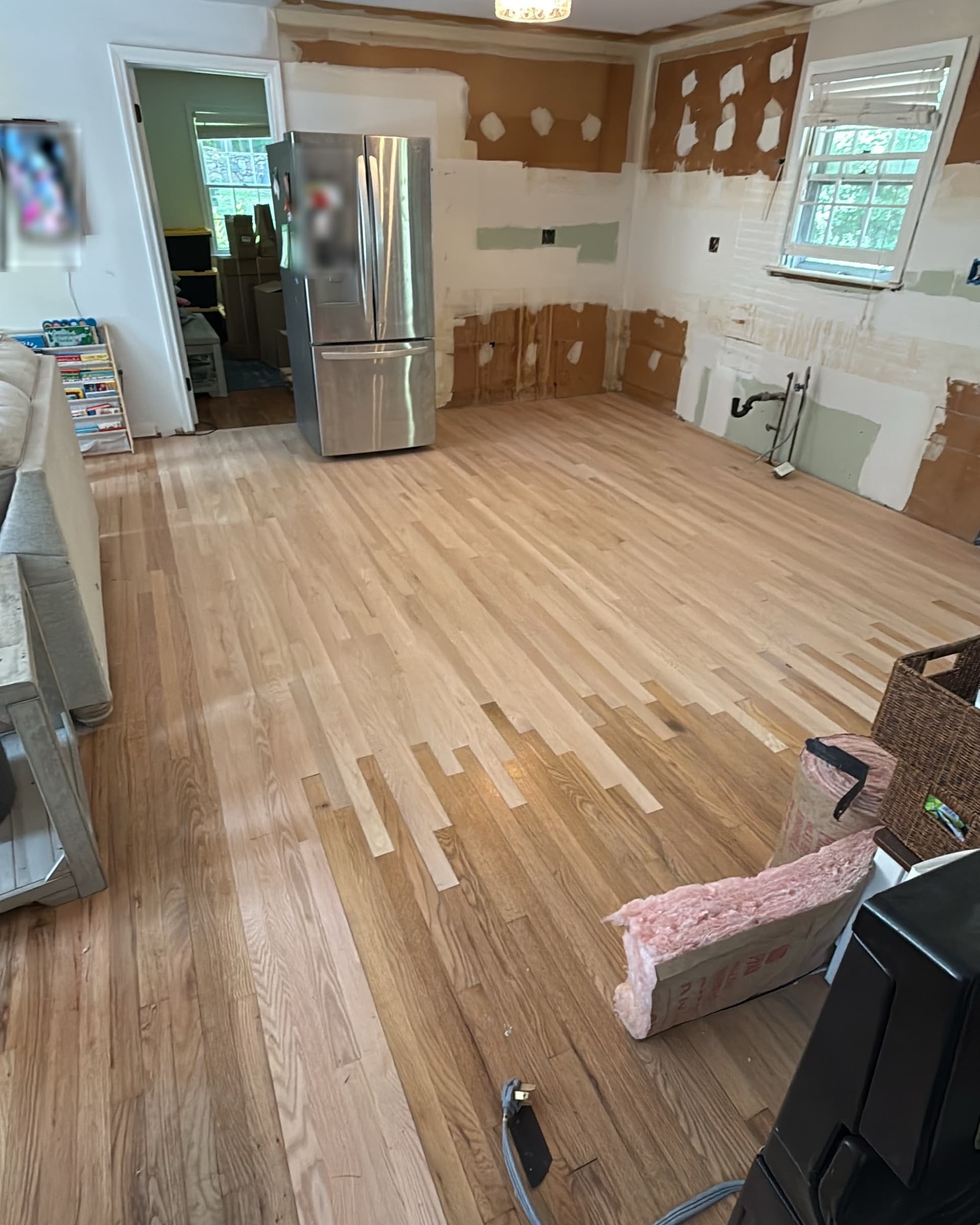
A straight patch can leave an obvious line across random-length strip flooring. In some solid-wood repairs, selected existing board ends can be removed at staggered points so new boards weave into the retained floor. The connected area may then need sanding and finishing for a more consistent result. Exact feasibility depends on the existing floor; a successful project elsewhere is not a promise for yours.
In an August 2026 Simsbury restoration project, Floors Now removed 101 square feet of flood-damaged hardwood while preserving the intact adjoining floor. The team installed 271 square feet of unfinished 2 1/4-inch Select & Better solid red oak, weaving the new boards into the retained kitchen and dining-room floor. Sanding and refinishing were scheduled later, so the installation photograph intentionally shows unfinished wood.
Two different finish treatments
Choose a maintenance coat or a full sand and refinish for the condition
A maintenance coat cleans and prepares the existing finish so a compatible new coat can be applied. It can renew a sound but worn surface, but it does not flatten dents, remove deep scratches, change board damage, or solve a moisture problem. Prior wax, oil, polish, cleaner residue, and unknown coatings can interfere with adhesion and must be investigated.
A full sand and refinish removes the old finish and a small amount of wood. It can address more substantial, widespread surface damage and offers an opportunity to change color, but each sanding reduces usable thickness. Fastener depth, board flatness, bevels, prior sanding, damage, and engineered wear-layer construction determine whether there is enough safe material.
Floors Now's August 2026 Monroe project covered sanding, staining, and finishing 652 square feet of existing hardwood in three rooms after flood damage. No repair and no new flooring were part of that verified scope. The Simsbury and Monroe projects demonstrate why 'fixing hardwood' is not one interchangeable service.
Do not promise an exact color match
Wood ages, old finishes amber or wear, products change, and repaired boards may absorb color differently. Physical samples and test areas improve the decision, but a localized repair can remain visible—especially under changing daylight.
When preservation stops making sense
Replacement may be safer when the problem is broad or structural
Replacement becomes more likely when boards are widely damaged, the subfloor or fastening system has failed, repeated moisture has caused major movement, the surface is too thin to sand safely, contamination cannot be corrected in place, or an isolated patch would affect most of the room. It can also be practical when the homeowner needs a different construction for the location.
Replacing the visible boards still does not correct an active leak, damp slab, wet crawlspace, unstable subfloor, or uncontrolled indoor climate. Build those corrections into the scope. When only part of a connected floor is replaced, plan the transition, height, direction, and honest expectation for matching the retained area.
Prepare for a useful inspection
Collect the information that changes the recommendation
Bring product records if you have them, including leftover boards, invoices, finish or cleaner names, installation date, and prior refinishing history. Mark the affected area, share photographs from when the event occurred, and disclose every cleaner, polish, coating, or spot treatment used. If water was involved, note its source, duration, cleanup, and any readings or restoration work.
Floor construction
Solid or engineered; board dimensions; factory- or site-finished; installation method; and any known wear-layer information.
Problem extent
One board, one room, or connected spaces; surface-only or movement; stable or still changing.
Cause and conditions
Leak, spill, pet damage, impact, grit, sunlight, humidity, or unknown—with the source corrected before finish work.
Desired result
Stop damage, make a safe functional repair, renew sheen, change color, or create the closest practical visual blend.
Plain-language answers
Common questions
Can one damaged hardwood board be replaced?
Often, but not automatically. The surrounding floor, subfloor, construction, profile, dimensions, fastening, and access must allow it, and compatible material must be available. The new board or finish may remain visibly different from aged flooring.
What is the difference between recoating and refinishing hardwood?
A maintenance coat prepares the existing finish and adds a compatible coat without sanding to bare wood. Refinishing sands away the old finish and some wood before new stain or finish is applied. Recoating cannot remove deep damage or change the underlying wood color.
Can engineered hardwood be refinished?
Some can be sanded, some may support only limited abrasion or recoating, and some should not be sanded. The real-wood surface thickness, construction, bevels, flatness, fasteners, prior work, damage, and manufacturer guidance all matter. Inspect the actual floor.
Should cupped hardwood be sanded flat right away?
No. Cupping can indicate a moisture difference through the board. Identify and correct the source, document conditions, and allow an appropriate evaluation and drying process. Sanding while the floor is still distorted can create a new shape problem as moisture changes.
Does flood-damaged hardwood always need replacement?
Not always, and not every flood-damaged floor can be saved. Water source, exposure, contaminants, construction, subfloor, movement, drying, remaining material, and health or restoration requirements determine whether cleaning, repair, refinishing, or replacement is appropriate.
Checked, not guessed
Sources and technical review
Reviewed on September 11, 2026 by Floors Now! flooring team, Connecticut flooring sales and installation team. The sources below support the general guidance. The instructions, room approvals, cleaner list, installation guide, and warranty for the exact product you buy always take priority.
- National Wood Flooring Association: Refinishing Your Floors
Distinguishes a maintenance coat from sanding and refinishing and lists factors that limit future sanding.
- National Wood Flooring Association: How to Clean and Take Care of Your Wood Floors
Covers dry soil removal, limited moisture, spill response, cleaner mistakes, and household humidity.
- National Wood Flooring Association: Technical Guidelines and Publications
The association's current library of installation, sanding, moisture, climate, and problem-diagnosis guidance.
- National Wood Flooring Association: Find a Wood Flooring Professional
Describes the training and hands-on testing behind NWFA professional certifications and inspections.
Keep planning
Hardwood Product Guide
Compare construction and refinishing potential before choosing replacement material.
serviceMoisture Testing and Mitigation
Investigate site moisture before treating visible floor movement as a finish problem.
serviceFloor Repair Services
Request a statewide repair evaluation for localized hardwood damage, matching-material questions, and repair-versus-replacement planning.
projectSimsbury Hardwood Weave-In Repair
See a verified selective removal and unfinished solid-red-oak installation after flood damage.
projectMonroe Hardwood Refinishing
See a separate, refinishing-only restoration scope with no repair or new floor installation.