
Carpet · Problems and repairs
What Is Carpet Stretching? Causes of Ripples, Repair Options, and Limits
A visible wave is more than a cosmetic nuisance. It can create a trip point, collect wear on its crest, and signal that the carpet, cushion, tack strip, seams, or conditions below need inspection.
The short answer
Carpet stretching tightens fitted broadloom carpet over its supporting cushion and secures it to the perimeter tack strip. Professional restretching usually means releasing enough of the carpet, inspecting the tack strip, cushion, seams, backing, and floor, then using a power stretcher—not only a knee kicker—to tension and reattach it. It may correct a sound carpet that has become loose, but it cannot reverse delaminated backing, badly damaged edges, contamination, chronic moisture, or carpet that no longer has enough usable material.
What matters most
- Treat ripples as an inspection issue and a possible trip hazard, not just an appearance flaw.
- A power stretcher applies controlled tension across the room; a knee kicker is not a substitute for the main stretch.
- The adjoining rooms, seams, tack strip, cushion, backing, and moisture conditions can affect the repair scope.
- Do not trim, glue, or pull a ripple before its cause and available carpet are understood.
- Restretching improves fit; it does not make aged or damaged carpet look new.
Start with diagnosis
The same-looking wrinkle can have different causes
Stretch-in carpet is installed over cushion and held at the room perimeter. If it was not tensioned correctly at installation, or if its attachment loses grip, extra material can rise into waves. Loose or poorly placed tack strip, a wrinkled cushion, disturbed seams, and heavy furniture dragged across the floor can also contribute to movement. Changes after wet cleaning or a water event deserve separate attention because moisture may have affected the carpet, cushion, backing, or subfloor.
Do not diagnose the cause from a photograph alone. A technician needs to know when the ripple appeared, whether it changes with weather, whether furniture or doors have trapped the carpet, whether adjoining rooms share the same piece, and whether there has been a leak, flood, pet contamination, or repeated cleaning issue. The backing must still be sound enough to accept tension.
Make the path safe
A raised ripple can catch a foot or vacuum. Keep the area clear, avoid running a vacuum over the crest, and arrange an evaluation rather than flattening it with adhesive, nails, or a cut.
The work
Restretching is more than pushing the wrinkle toward a wall
The Carpet and Rug Institute's restretching bulletin calls for furniture removal, release of the carpet from tack strip, inspection of the strip and cushion, confirmation that the backing has not separated, and power stretching across the connected area. Doorway seams may need to be opened and remade as the carpet moves. Vents, transitions, and exposed edges may need new pieces or edge sealing. Excess carpet is trimmed only after the new position is established.
A power stretcher uses tubes and a padded end against the opposite wall to apply controlled force across the room. A knee kicker is useful for positioning and securing certain areas, but CRI states that it cannot produce the main stretch needed to prevent wrinkles from returning. Patterned, woven, specialty, glued, and attached-pad carpets can require different procedures, so the carpet maker's instructions still matter.
| Check | Why it matters |
|---|---|
| Carpet construction and backing | Separated, brittle, torn, or heavily stretched backing may not hold new tension |
| Tack strip and perimeter | Loose, rusty, damaged, or misplaced strip may need correction first |
| Cushion | Wrinkled, wet, contaminated, or deteriorated pad can remain a problem below the surface |
| Seams and connected spaces | Moving one area can affect doorways, halls, closets, and adjoining rooms |
| Water and odor history | Moisture or contamination may turn a fit problem into a removal or replacement decision |
Repair decision
A sound carpet with enough material is the best candidate
Restretching is most promising when the carpet is otherwise in useful condition, the backing is intact, the cushion and tack strip can support the repair, the edges have enough material, and the looseness can be addressed across the connected area. A newer carpet that was inadequately stretched at installation may fit this description, but responsibility and warranty should be discussed with the original retailer or installer before another party alters it.
Replacement becomes more practical when the backing is separating, edges are too damaged to secure, multiple seams are failing, the surface is badly worn or contaminated, the cushion has widespread damage, or a recurring moisture source remains. Restretching also cannot restore pile crushed by years of traffic, replace missing fiber, remove bleach loss, or guarantee invisible seams. The repair goal should be a safer, more secure fit—not a new-carpet appearance.
Call the original seller first when appropriate
A recent installation may have workmanship or product-warranty steps that should be documented before anyone else changes it.
Separate fit from appearance
A successful restretch can remove looseness while old traffic lanes, fading, edge pulls, or seam visibility remain.
Fix moisture before flooring
If water or chronic dampness is involved, identify and correct the source before deciding what material can safely stay.
Real project evidence
One Kensington repair shows why the scope is product-specific
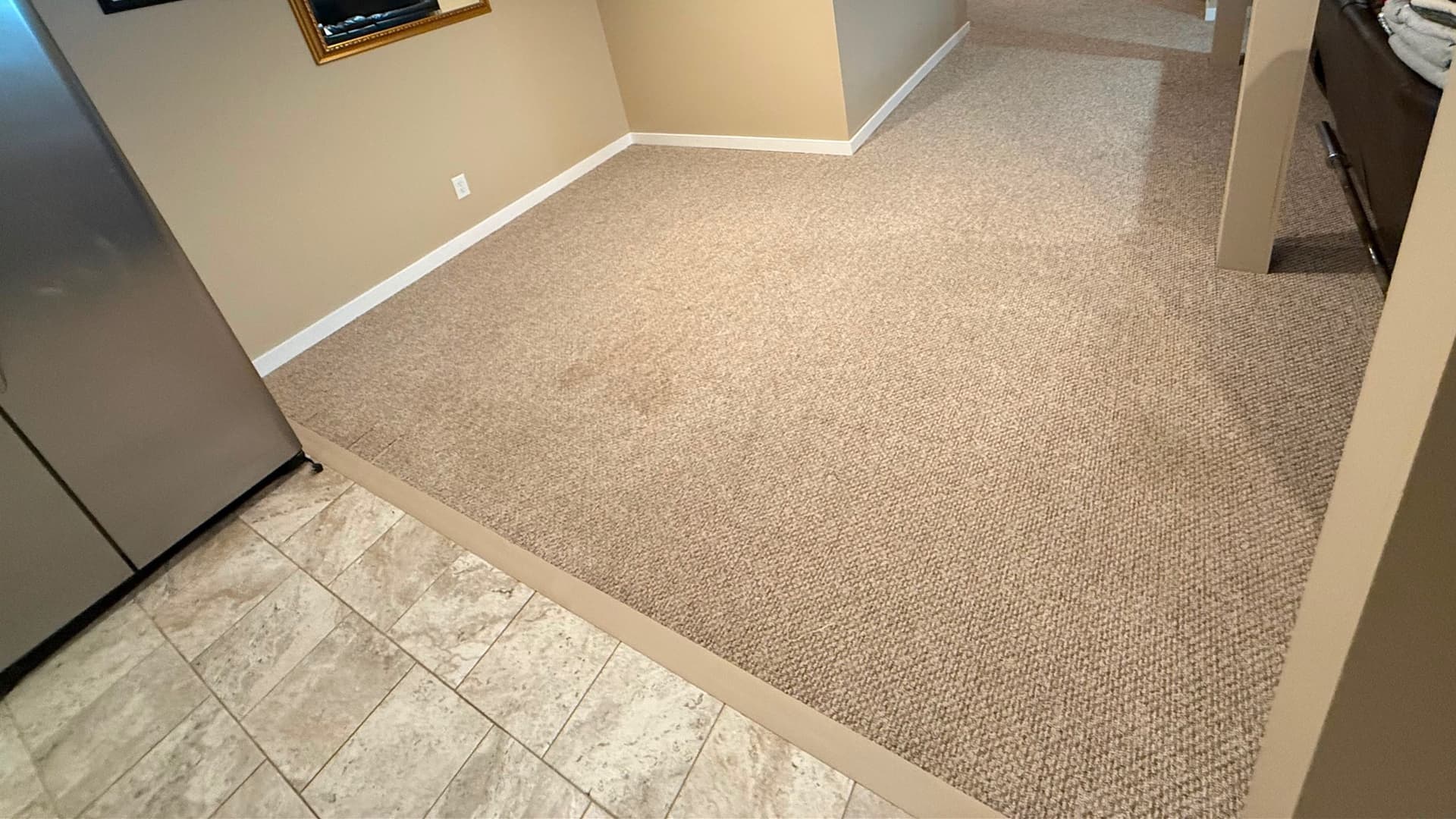
In August 2026, Floors Now documented a finished-basement project in Kensington, within the Town of Berlin, where the customer wanted to retain the existing carpet. The crew installed new cushion in the approved area, corrected tack strip that had been set too close to the baseboard, restretched the retained carpet, and added a vinyl transition. The work was completed in a few hours.
The project record also preserves the limitation: the existing carpet already had pulls along some edges, so the finished result was not represented as equivalent to new carpet. It is a useful example of inspection leading to a focused scope, not proof that every wrinkle can be repaired or that the same work is available or appropriate for every request. Floors Now can review the documented conditions and discuss an honest next step, including replacement when repair is not suitable.
Prepare
Make the first conversation more useful
Photograph the full room and close views without walking on the ripple. Note the carpet age, installation date, product name if known, when the problem started, recent furniture moves, cleaning, indoor-climate changes, and every water or pet event. Identify connected closets, halls, stairs, and rooms. Do not remove doors, transitions, or baseboard just to investigate unless directed.
Have the warranty ready
The carpet and installation documents may define the proper claim path and approved repair method.
Clear the cause, not necessarily the room
Ask who must move furniture and how much connected carpet must be accessible before emptying the space yourself.
Expect a conditional answer
The condition of backing, cushion, seams, tack strip, and floor may only become fully visible after the edge is released.
Plain-language answers
Common questions
Can I flatten a carpet ripple with a knee kicker?
A knee kicker helps position carpet but is not a substitute for the controlled main stretch. CRI's residential standard requires a power stretcher for stretch-in installation, and its restretching bulletin says a knee kicker cannot produce adequate stretch to prevent recurring wrinkles.
Does all furniture have to leave the room?
CRI's restretching guidance calls for removing all furniture because carpet often must be released and moved across the connected area. A professional should confirm the exact access and furniture plan before work starts.
Can just one ripple be stretched?
Sometimes the visible symptom is local, but the carpet may run through a doorway or connect to a larger area. Restretching one room while leaving an adjoining area loose can allow wrinkles to return. The full layout needs inspection.
Will restretching make old carpet look new?
No. It may improve fit and safety, but it does not reverse fading, crushing, stains, pulled edges, worn pile, damaged backing, or seam visibility.
When should rippled carpet be replaced instead?
Replacement may be safer when backing has failed, edges cannot hold, seams or pile are badly damaged, pad is contaminated, moisture keeps returning, or the carpet has reached the end of its useful condition. An inspection should separate a correctable fit issue from wider failure.
Checked, not guessed
Sources and technical review
Reviewed on September 11, 2026 by Floors Now! flooring team, Connecticut flooring sales and installation team. The sources below support the general guidance. The instructions, room approvals, cleaner list, installation guide, and warranty for the exact product you buy always take priority.
- The Carpet and Rug Institute: Guidance for Restretching to Remove Buckles, Wrinkles, and Bubbles
Technical bulletin covering furniture removal, tack strip and cushion inspection, backing condition, connected rooms, seams, and power stretching.
- The Carpet and Rug Institute: CRI 105 Standard for Installation of Residential Carpet
Industry standard requiring power stretching for stretch-in residential carpet and manufacturer-specific stretch instructions.
- The Carpet and Rug Institute: Residential Carpet Installation Tips
Consumer guidance on professional installation, seams, edge sealing, power stretching, and contacting the retailer about later wrinkles.
Keep planning
Kensington Restretch Project
Review the documented cushion, tack-strip, restretch, transition, and existing-edge limitations.
serviceFloor Repair Services
Request a statewide repair evaluation when carpet condition, access, and the surrounding floor make repair worth reviewing.
productCarpet Product Guide
Compare current carpet choices when replacement is the more practical path.
serviceFlooring Removal
Understand what removal can reveal when moisture, damaged cushion, or failed carpet cannot remain.
articleCarpet Care Guide
Learn which appearance changes respond to maintenance and which deserve inspection.