
Hardwood · Rooms and moisture
Hardwood Flooring and Humidity in Connecticut
Connecticut homes can move from humid summers to dry heating seasons. Wood responds to those indoor—not simply outdoor—conditions, so the plan must cover product selection, testing, installation, and year-round climate control.
The short answer
Hardwood can perform well in Connecticut when the exact product is suitable for the room and the home is kept within its required temperature and relative-humidity range. Wood naturally gains moisture and expands in more humid conditions, then loses moisture and shrinks as indoor air dries. Engineered construction generally moves less across the board than comparable solid wood, but it is not humidity-proof. Test and document the jobsite, condition material according to the manufacturer's instructions, and maintain the approved indoor range after installation.
What matters most
- The flooring warranty's stated indoor range controls; a generic humidity target is only a discussion starting point.
- Acclimation is about reaching suitable moisture conditions—not waiting an automatic number of days.
- Basements, crawlspaces, slabs, plumbing, and wet construction can affect wood even when the room air feels comfortable.
- Small seasonal changes may be normal; persistent or severe gaps, cupping, buckling, or cracks deserve investigation.
Normal material behavior
Why wood changes when indoor air changes
Wood is hygroscopic, which means it exchanges moisture with the surrounding air. As its moisture content rises, it generally expands; as it falls, it generally shrinks. Movement is usually greater across a board's width than along its length. That is why room climate, board width, cut, species, construction, and installation details all matter.
Connecticut weather influences the home, but the floor experiences indoor conditions. Air conditioning and dehumidification may control humid summer air; heating can make winter air very dry. A closed seasonal home, a changed thermostat, a new humidifier, wet basement, or long HVAC outage can move conditions beyond what was present at installation.
No species is universally humidity-proof. Hardness and moisture movement are different traits. Choose the full product and construction for the room, then follow its written limits.
Construction matters
Engineered hardwood can broaden options, but it still contains real wood
Solid flooring is one piece of wood. Engineered flooring uses a real-wood surface over layers arranged to improve dimensional stability. That can make an engineered product a candidate for some slabs, lower levels, wider boards, or installation methods where solid wood is not approved—but only when its manufacturer says so.
Engineered products vary in core construction, real-wood surface thickness, edge, adhesive compatibility, backing, and humidity limits. Do not assume every engineered board can float, go below ground, cover radiant heat, or be sanded. Likewise, solid hardwood may be entirely appropriate on and above ground when the subfloor, moisture, fasteners, and conditions meet its instructions.
| Decision | Solid hardwood | Engineered hardwood |
|---|---|---|
| Location | Commonly on or above ground; verify exact approval | May offer more below-ground or slab options; verify exact approval |
| Movement | Responds directly as one wood piece | Layered construction generally reduces dimensional change |
| Installation | Often nail or staple over a suitable wood subfloor | May allow nail, staple, glue, or floating methods depending on product |
| Refinishing | Often more sanding potential, subject to thickness, fasteners, and prior work | Potential varies with the real-wood surface and construction |
| Humidity | Must stay within the product's stated range | Still real wood and must stay within the product's stated range |
Measure before delivery and installation
Evaluate the room, the flooring, and what is underneath
The building should be enclosed, wet construction should be complete, and the heating or cooling system should be operating as required before hardwood is delivered. Record temperature and relative humidity in the rooms, then evaluate the wood flooring and subfloor with the appropriate methods. Concrete and wood subfloors need different tests and are compared with the flooring and adhesive manufacturer's limits.
Look beyond the room air. Exterior drainage, plumbing, slab moisture, a damp crawlspace, an unfinished basement, and recently poured or patched materials can feed moisture into the system. An acceptable reading in one convenient spot cannot represent every room or every moisture source.
The current NWFA Installation Guidelines provide industry methods, but the selected floor and installation-product instructions remain essential. Document readings, dates, rooms, and test methods rather than relying on memory.
Condition, do not count days
Acclimation ends when the required conditions are met
A universal 'leave it in the house for two or three days' rule is unreliable. Some products require a defined conditioning period; others focus on measured moisture and expected service conditions; packaging and storage instructions also differ. Material placed in a damp basement, unopened in the wrong climate, or beside active construction is not safely acclimating simply because time passes.
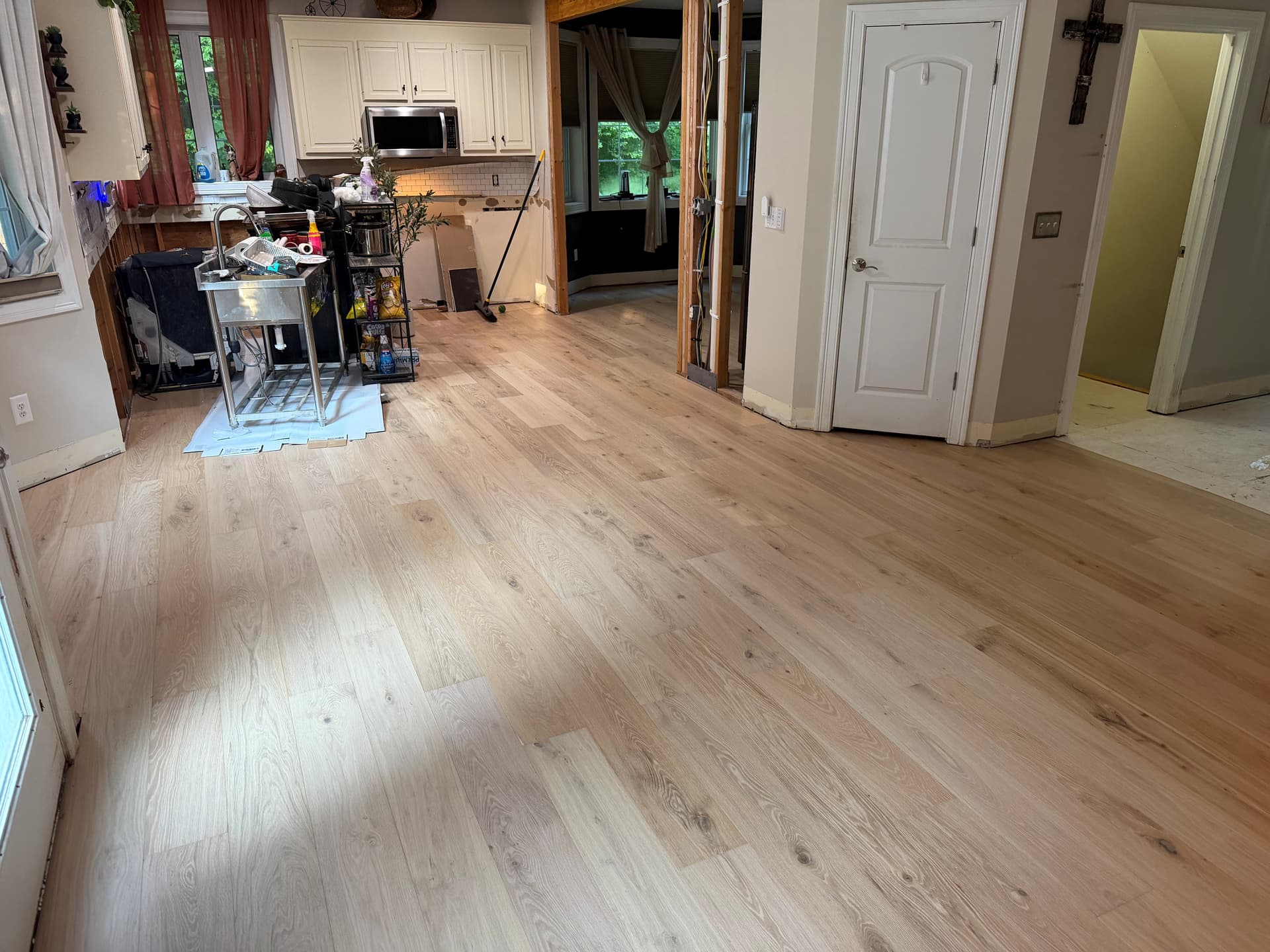
In a verified August 2026 West Hartford project, Somerset solid red oak was delivered after hours so it could remain in the home for the product-specific three-day acclimation plan before installation. That project detail is evidence of schedule coordination, not a rule for other brands or homes. Follow the current instructions for the floor being installed.
Plan acclimation before setting the installation date
Delivery access, room temperature, humidity, moisture readings, packaging, stack arrangement, and other construction all affect the schedule. The material should not arrive before the site is suitable for it.
Ownership continues after installation
Keep the home inside the exact product's approved range
Use a reliable humidity monitor in the living space and consider more than one location in a large or multi-level home. Operate air conditioning, dehumidification, heating, or humidification as needed, and maintain the home during vacations. The correct target is the intersection of the floor manufacturer's published range, the home's conditions, and safe equipment operation.
Address wet basements, crawlspace moisture, roof or plumbing leaks, and exterior water management rather than asking the HVAC system to hide them. Clean spills promptly and avoid standing water. Rugs and furniture can create local differences in heat, moisture, or light, especially over radiant systems, so follow product guidance.
Humid season
Watch for rising indoor humidity, condensation, musty lower levels, and raised board edges; use appropriate cooling or dehumidification.
Heating season
Watch for very dry air, pronounced gaps, splits, and rapid thermostat changes; use humidification only when appropriate and safely controlled.
Away from home
Do not shut down climate control without checking the floor's required range and the building's freeze, humidity, and ventilation needs.
After a leak
Stop the source, document conditions, and evaluate hidden layers; do not wait for the surface alone to look dry.
Know when to investigate
Read gaps and shape changes in context
Small gaps that appear during a dry heating season and narrow when normal conditions return can reflect ordinary seasonal movement. Persistent large gaps, cracks, loose boards, or concentrated changes may point to excessive dryness, installation details, or other causes. Measure conditions and compare the pattern over time.
Cupping means board edges are higher than their centers and often indicates more moisture on one side of the board than the other. Crowning is the reverse shape and may follow other moisture or sanding conditions. Buckling or lifting is more severe movement. These descriptions are clues, not remote diagnoses; correct active moisture and arrange an onsite evaluation before sanding or replacement.
Plain-language answers
Common questions
What humidity should I keep for hardwood floors?
Use the exact flooring and finish manufacturer's written range. Many industry and manufacturer resources discuss ranges around normal conditioned-home levels, but products differ, and a generic number does not replace the warranty. Monitor conditions throughout the year.
Is engineered hardwood safe from humidity changes?
No. Its layered construction generally improves dimensional stability, but the surface is real wood and the full product still has room, moisture, temperature, and humidity limits. It can be damaged when those limits or installation requirements are ignored.
How many days should hardwood acclimate in Connecticut?
There is no universal day count. Follow the current manufacturer instructions and verify that the jobsite, subfloor, flooring moisture, temperature, humidity, storage, and expected living conditions meet the requirements. Time alone does not prove readiness.
Are winter gaps in hardwood normal?
Some seasonal shrinkage can occur as indoor air dries, especially in solid wood. The width, pattern, persistence, construction, climate readings, and product requirements determine whether it is expected or needs investigation. Do not fill seasonal gaps before understanding how they change.
Can solid hardwood go in a Connecticut basement?
Solid hardwood is generally not intended below ground. Some engineered products may be approved for selected basement installations, but slab or subfloor moisture, vapor control, installation method, climate, and manufacturer requirements still must be addressed. Verify the exact product.
Checked, not guessed
Sources and technical review
Reviewed on September 11, 2026 by Floors Now! flooring team, Connecticut flooring sales and installation team. The sources below support the general guidance. The instructions, room approvals, cleaner list, installation guide, and warranty for the exact product you buy always take priority.
- National Wood Flooring Association: 2025 Wood Flooring Installation Guidelines
Industry technical guidance for site conditions, moisture evaluation, subfloors, layout, and installation methods.
- National Wood Flooring Association: Types of Wood Floors
Explains solid and engineered construction, board formats, species, grade, and saw cut in consumer-friendly terms.
- Somerset Hardwood Flooring: Solid Hardwood Installation Guidelines
A manufacturer example showing how jobsite conditions, moisture records, acclimation, subfloor work, layout, and exact instructions affect an installation.
- Somerset Hardwood Flooring: Engineered Hardwood Installation Guidelines
A manufacturer example of product-specific requirements for engineered hardwood, moisture, approved methods, and long-term room conditions.
Keep planning
Hardwood Product Guide
Compare solid and engineered construction, locations, installation, and refinishing potential.
serviceMoisture Testing and Mitigation
Plan appropriate testing and a product-specific moisture system before installation.
articleClean and Protect Hardwood
Add climate, spill, entry, furniture, rug, and sunlight protection to routine care.
projectWest Hartford Solid Red Oak Project
See how a product-specific acclimation window was protected within a real installation schedule.