
Carpet · Rooms and moisture
Can You Put Carpet in a Basement? Moisture, Padding, and Product Choices
Carpet can make a dry finished basement feel warmer, quieter, and more like the rest of the home. The decision should begin below the surface, because carpet and pad can conceal moisture that a hard floor would reveal sooner.
The short answer
You can install carpet in a basement when the space has no active leak, seepage, recurring condensation, musty odor, or unresolved water history; the concrete and room conditions meet the requirements of the selected carpet, cushion, and installation system; and you accept that saturated carpet and padding can be difficult or impossible to save after a flood. Inspect and correct moisture first. Then choose a product and cushion approved for below-grade use and make a realistic plan for dehumidification, spills, sump or plumbing failures, cleaning, and future removal.
What matters most
- A dry-looking slab on one visit does not erase a history of seasonal seepage, condensation, or flooding.
- Moisture must be evaluated for the complete carpet, cushion, adhesive or attachment, and concrete system.
- Carpet tile may simplify localized replacement, but it is not waterproof and still needs an approved dry substrate and installation.
- Cushion should be approved for both the carpet and basement installation; an added moisture claim does not repair a wet building.
- Choose another floor when chronic water risk cannot be corrected or quick cleanup is the overriding priority.
Before samples
Ask what the basement has done in every season
Start with evidence, not the finish you hope to buy. Look for wall or slab staining, white mineral deposits, peeling paint, rust, damp baseboard, musty odor, previous mold cleanup, cracks that have admitted water, plumbing incidents, overflowing window wells, sump-pump failures, and unusually heavy dehumidifier use. Ask what happened during spring rain, summer humidity, winter freeze-thaw cycles, and power outages—not only how the room feels today.
Any active or recurring source needs diagnosis and correction before flooring. Carpet is porous, and cushion sits out of sight. The U.S. Environmental Protection Agency warns that carpet backing and pad must also dry after they become wet and that porous material with mold may have to be discarded. A moisture-barrier label on a pad cannot stop groundwater, repair drainage, or make trapped water harmless.
| Basement condition | Carpet decision |
|---|---|
| Active leak, seepage, or standing water | Stop. Correct and verify the source before choosing flooring. |
| Musty odor, visible growth, or unknown prior water damage | Investigate safely; flooring selection comes after remediation decisions. |
| No known event, but concrete condition is untested | Evaluate the slab and selected installation system before ordering. |
| Dry, controlled space with acceptable test results | Compare below-grade-approved carpet, cushion, and installation choices. |
| Water risk remains high despite mitigation | Choose a more recoverable strategy and preserve access for inspection. |
Concrete and indoor conditions
Use the test required by the installation—not a taped-plastic guess
Concrete can transmit water vapor even when its surface looks dry. For direct-glue and other applicable systems, CRI's residential installation standard calls for recognized moisture, internal relative-humidity, and alkalinity testing and requires results to stay within the flooring and adhesive makers' limits. The correct tests, quantity, timing, and responsibility depend on the project and installation method. A quick home test is not a warranty-quality substitute.
Test results describe conditions at the time and locations tested; they do not repair exterior drainage or predict every future pipe, appliance, or sump failure. Keep the basement's temperature and humidity within the selected product's requirements, operate needed dehumidification, and watch for condensation on cold surfaces. If a system uses a vapor barrier, raised subfloor, adhesive, or attached backing, every component must be compatible—do not assemble layers from unrelated advice.
Manufacturer limits decide
Below-grade approval, concrete limits, cushion, adhesive, and installation instructions must come from the exact products being installed. A general claim about 'basement carpet' cannot override them.
Product and installation
Broadloom, carpet tile, cushion, and attachment change the recovery plan
Stretch-in broadloom over cushion creates the familiar soft residential feel, but a large piece and separate pad may need lifting or replacement after significant water. Direct-glue broadloom eliminates a separate cushion in some systems but ties performance to concrete preparation, moisture and pH limits, adhesive, and drying conditions. Carpet tile can make a damaged section easier to access or replace when matching attic stock remains, yet seams and removable modules do not make it waterproof.
Choose cushion by the carpet maker's requirements for type, thickness, density, and application. A firmer cushion can support busy basement paths better than an overly soft one. Attached moisture barriers or spill-control features may help manage some top-down spills under their stated conditions, but water can still reach edges, seams, walls, or the slab. Ask exactly what the feature does, what it does not do, and how a wet assembly would be inspected and dried.
Match the activity
Media seating, play, exercise equipment, storage, a laundry route, and exterior access place different demands on one basement.
Keep extra material
Retained carpet tile or broadloom remnants can help with a future localized repair, but dye lots and products change.
Plan transitions and height
Stairs, doors, mechanical-room thresholds, drains, and adjoining hard floors affect cushion and subfloor choices.
A real Connecticut project
Different activities may deserve different floors
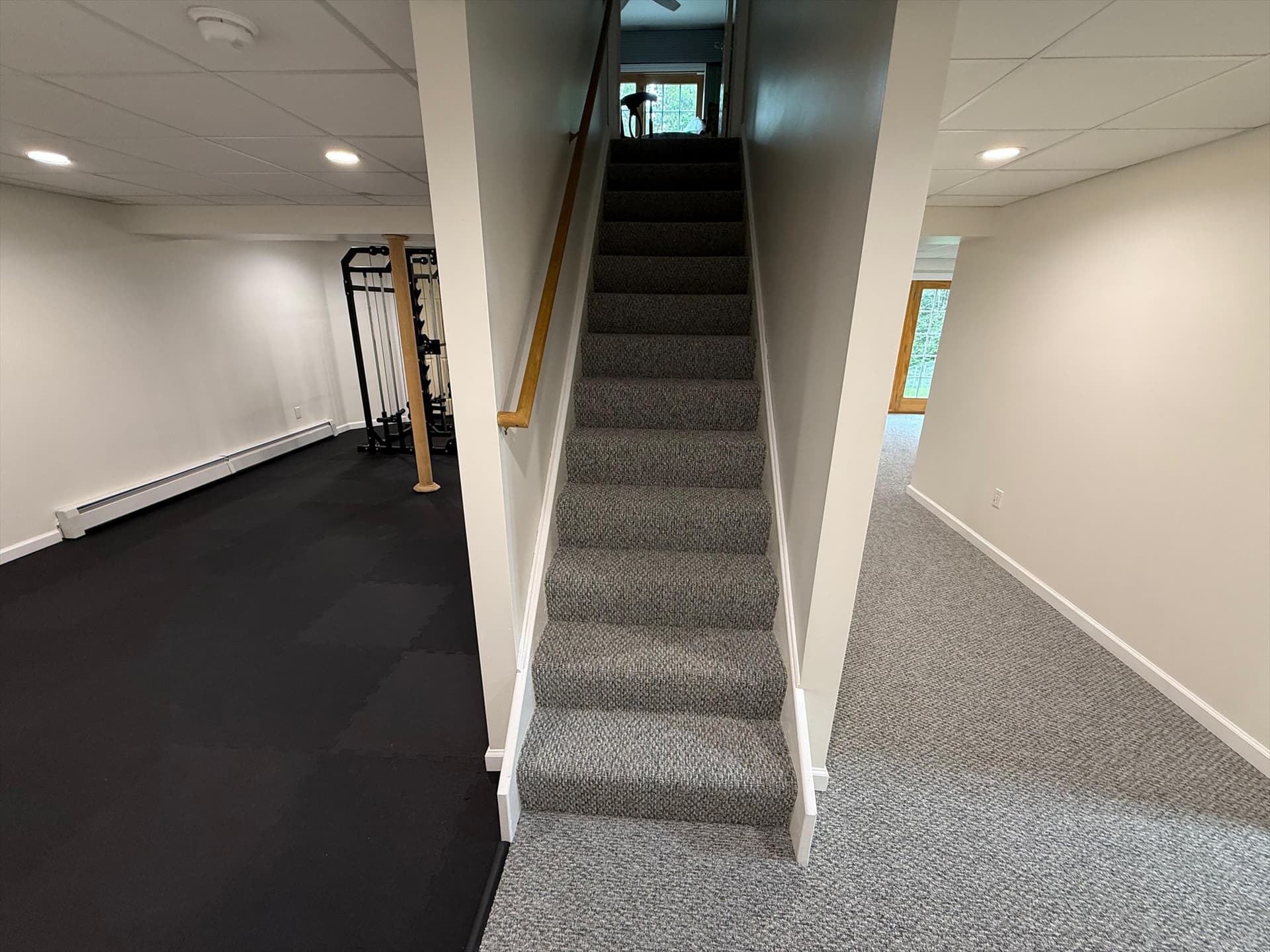
A documented Colchester restoration project paired Madoc carpet and new pad in the planned carpeted areas and on two staircases with interlocking rubber tiles in the separate home-gym area. That choice acknowledged that a comfortable passage or living zone and a gym floor do not have identical needs. The project also demonstrates why room boundaries, transitions, stairs, and equipment need to be designed together.
A similar plan can keep carpet away from a utility sink, mechanical equipment, an exterior door, or another predictable wet or messy zone while preserving softness in the finished living area. Another basement may be better served entirely by an approved resilient or tile system. The right answer comes from the water risk and room use, not from wanting one continuous visual at any cost.
Ownership plan
Know what you will do if the carpet gets wet
Write down where the main water shutoff is, how the sump is powered, who responds to a leak, and how quickly the carpet and cushion can be accessed. The EPA advises drying wet materials promptly, generally within 24 to 48 hours to reduce mold risk, but the water source and level of contamination change what can be saved. Sewage, groundwater, widespread mold, or a delayed discovery needs qualified remediation guidance—not a household fan and a hope that the surface feels dry.
After any significant event, stop the source and address electrical and personal safety first. Photograph the damage for insurance, contact the appropriate restoration professional, and have the carpet, cushion, baseboard, walls, and subfloor evaluated. Do not reinstall or cover material until the complete assembly and surrounding building materials are acceptably dry and the source has been corrected.
Before you buy
A yes-or-no checklist for the next showroom visit
Bring basement photos, approximate room measurements, the home's age, any existing floor layers, and a written water history. Tell the team about exterior doors, laundry or plumbing, sump equipment, radiant heat, gym gear, rolling chairs, pets, stairs, and the rooms used for storage. The selected product can then be checked against real conditions rather than a generic basement label.
Water source corrected
There is no active leak, recurring seepage, or unresolved condensation problem.
Complete system approved
Carpet, cushion or backing, adhesive or attachment, concrete, and any subfloor layer work together within written limits.
Climate can be maintained
Heating, cooling, ventilation, and dehumidification can keep the room within the product requirements.
Water response is realistic
You understand access, replacement limits, insurance considerations, and who to call after a leak or flood.
Plain-language answers
Common questions
Is carpet a good choice over a concrete basement floor?
It can be when the basement is dry and controlled, the concrete is evaluated as required, and the complete carpet system is approved for below-grade installation. Chronic leaks, seepage, condensation, or an unresolved musty odor should stop the flooring decision.
Does basement carpet need a moisture-barrier pad?
Use only a cushion approved by the carpet maker and appropriate for the installation. A barrier feature may manage certain top-down spills, but it does not stop slab moisture or repair a water-entry problem. Verify its exact purpose and limits.
Is carpet tile waterproof?
No. Carpet tile may allow localized access or replacement, but the face, backing, seams, adhesive, and substrate still have moisture limits. Check the exact tile and installation instructions.
Can wet basement carpet be saved?
It depends on the water source, time wet, extent, carpet and cushion condition, and surrounding materials. Clean-water events addressed immediately differ from sewage, groundwater, mold, or delayed discovery. Qualified water-damage guidance is appropriate for anything beyond a small, quickly controlled spill.
What flooring is better when a basement has flooded before?
First correct and evaluate the water source. If meaningful risk remains, compare more removable or recoverable assemblies and hard surfaces approved for the slab. No finish flooring makes an unresolved basement waterproof.
Checked, not guessed
Sources and technical review
Reviewed on September 11, 2026 by Floors Now! flooring team, Connecticut flooring sales and installation team. The sources below support the general guidance. The instructions, room approvals, cleaner list, installation guide, and warranty for the exact product you buy always take priority.
- U.S. Environmental Protection Agency: What Are the Main Ways to Control Moisture in Your Home?
Federal guidance on basement seepage, condensation, carpet over concrete, vapor strategies, and the priority of moisture control.
- U.S. Environmental Protection Agency: Mold Course Chapter 4: General Remediation Issues
Guidance on prompt drying, carpet and cushion access, water extraction, dehumidification, and porous-material limitations.
- The Carpet and Rug Institute: CRI 105 Standard for Installation of Residential Carpet
Industry requirements for substrate readiness and recognized concrete moisture, relative-humidity, and alkalinity testing for applicable installations.
- U.S. Environmental Protection Agency: The Inside Story: A Guide to Indoor Air Quality
Federal advice addressing wall-to-wall carpet over concrete in contact with the ground, ventilation, moisture barriers, and wet-carpet removability.
Keep planning
Carpet Room-Fit Guide
Compare why bedrooms and living spaces are strong fits while finished basements remain project-dependent.
serviceCarpet Installation
Plan the carpet, approved cushion, surface, seams, edges, and transitions as one scope.
projectColchester Basement Carpet and Rubber Project
See a real restoration scope that used separate carpet and home-gym flooring zones.
productLuxury Vinyl Product Guide
Compare an alternative resilient floor while keeping product approvals and moisture limits in view.
articleCarpet Warmth and Sound
Understand the comfort carpet and cushion can add once the basement itself is suitable.