01
Start with daily use
Describe walking paths, rolling chairs, tracked-in dirt, pets, and any moisture history. Think about the busiest part of the floor.
Newington showroom • Serving Connecticut

Carpet tile product guide
Compare fibers, backing, pattern, and performance for your home or business. Compare room suitability, layout choices, and the advantages of a modular floor.
Request a free carpet tile estimate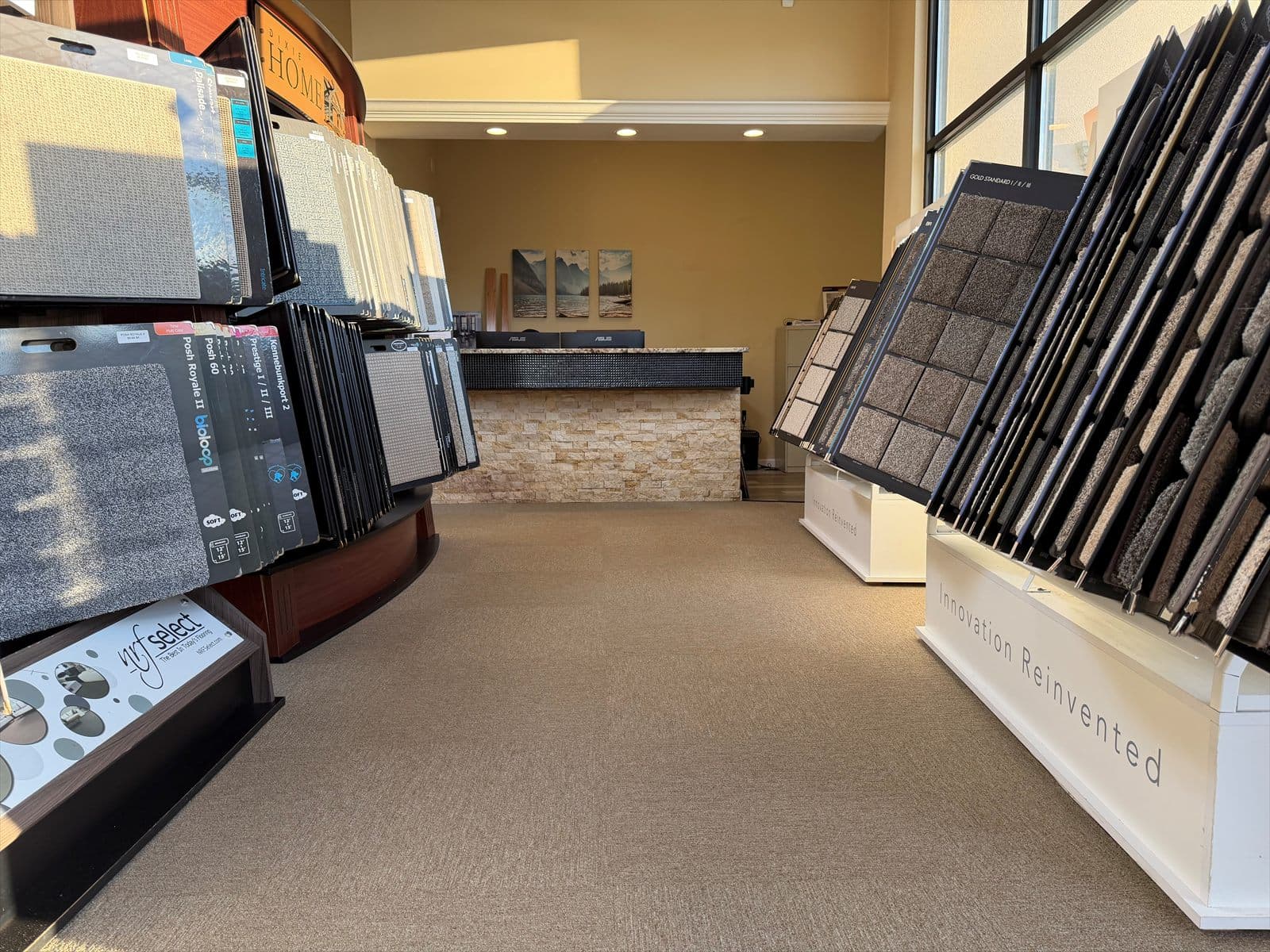
Carpet tile, also called modular carpet, comes in individual squares or planks. It can make local repairs, creative layouts, and renovations easier to manage. Choose it around the way your space is used: a home office, playroom, and busy business corridor need different combinations of comfort, traffic performance, backing, and care.
01
Describe walking paths, rolling chairs, tracked-in dirt, pets, and any moisture history. Think about the busiest part of the floor.
02
Feel the backing as well as the yarn. Check the exact traffic rating, approved installation system, layout options, and warranty.
03
Include compatible spare modules in the order and compare replacement access. The attachment system and future product availability affect repair options.
Choose the format first
Broadloom arrives in rolls; carpet tile arrives in modules with a backing designed for that format. Both can work well, but they offer different repair options, underfoot feel, and installation details.
Scroll across the table to compare every column.
| Decision point | Carpet tile | Broadloom carpet |
|---|---|---|
| Format and finished look | Individual squares or planks create a modular floor. Joints may blend into the pattern or form part of the design. | Large rolls create a more continuous carpeted appearance. Room size and roll width still determine where seams are needed. |
| Comfort underfoot | Hardback feels firm; integrated cushion adds resilience. Compare complete samples to understand the difference before choosing. | Stretch-in carpet over suitable cushion usually offers a softer feel, particularly when bedroom comfort is the priority. |
| Localized repairs | Individual damaged modules can often be replaced. Include matching spares in the order and compare replacement access for the installation system. | Localized damage may need a patch or a larger replacement area. Repair visibility depends on the carpet and location. |
| Chairs and commercial traffic | Many commercial styles suit busy spaces and rolling chairs when the tile, backing, and installation system are approved for that use. | Approved glue-down constructions can suit commercial traffic. Soft stretch-in installations have different support and rolling-load limitations. |
| Renovation and design | Small modules simplify staging and phased work. Colors, planks, borders, and approved orientations offer flexible design options. | Roll handling requires more space. Patterns and borders remain possible, with seam placement and pattern repeats planned in advance. |
| Cost and material use | Cuts, layout, preparation, adhesive, and spare cartons determine total cost. Modular sizing can reduce waste on suitable floor plans. | Roll width, room geometry, seams, cushion, and installation affect the estimate. Compare installed quotes for the same project scope. |
Carpet tile is worth considering when selective replacement, access, or a patterned layout matters. If you want a plush, continuous feel in a bedroom, compare suitable broadloom over cushion too. Neither format guarantees a lower installed price or less waste in every room. Our Carpet guide covers broadloom fibers, cushion, and residential styles in more detail.
Look beneath the yarn
A carpet tile combines a visible textile surface with layers that hold its shape, support the yarn, and connect it to the floor. Two tiles with a similar face can feel and perform differently underneath.
A simplified carpet tile assembly
The fiber, color, and pile construction create the surface you see and walk on.
These hold tufted yarn in place and help keep the layers together.
This gives the module its body and helps it remain flat and stable. Chemistry and construction differ between products.
A resilient layer changes comfort, sound, and thickness. It is part of the specified tile.
Approved adhesive or connectors hold the tile field over a compatible, properly prepared surface.
Fiber and color
Nylon is a common commercial carpet tile fiber, but the fiber name alone cannot establish suitability. Construction, backing, use classification, and maintenance all influence the finished floor.
Scroll across the table to compare every column.
| Fiber | Useful strengths | Tradeoffs | What to check |
|---|---|---|---|
| Nylon | A common commercial choice for resilience and appearance retention when supported by suitable pile construction and backing. | Often costs more than entry-level alternatives. The fiber name alone does not establish a traffic rating or stain protection. | Compare use rating, density, dye method, and care requirements. Solution-dyed nylon is nylon colored during fiber production, not a separate fiber. |
| Polyester / PET | Available in selected modular products with appealing color, softness, stain resistance, and value. | Resistance to crushing and long-term traffic performance depend on the exact construction and intended use. | Confirm approval for your room, concentrated walking paths, and chair use instead of assuming all polyester tiles perform alike. |
| Olefin / polypropylene | Selected value and specialty products offer a moisture-resistant fiber and accessible material cost. | An under-specified product can crush or mat under demanding traffic. Fiber moisture resistance does not waterproof the installed floor. | Review traffic suitability, appearance expectations, and cleaning guidance for the exact product before choosing it for a busy area. |
| Wool / wool blends | Specialty modular options provide natural character, a premium appearance, and resilience. | Typically carry a higher price and require care suited to wool and any other fibers in the blend. | Confirm the actual fiber blend, stain limitations, approved maintenance, and application rating rather than applying synthetic-carpet cleaning rules. |
Pigment is introduced while the synthetic fiber is made. This can give strong colorfastness, which means resistance to losing or changing the original color. It is separate from stain resistance, which concerns unwanted discoloration from a spill. Solution-dyed nylon is still nylon, with a particular dye method.
Other yarn-dyeing and printing methods offer different design possibilities. Solution dyeing does not make every carpet stain-proof or automatically suitable for bleach, disinfectants, or aggressive spot cleaners.
Texture, feel, and traffic
Pile describes the visible yarn structure. A tight, low profile is often useful in busy spaces; a taller or more sculpted surface changes the feel, appearance, and cleaning needs.
Loops at a similar height create an even, tailored surface. Dense, low constructions can suit concentrated traffic when rated for it. Look closely at loop size and snag exposure, especially around pets or furniture.
Different loop heights and yarn effects create movement without relying only on color. Texture can soften the appearance of everyday traffic. See several modules together before deciding how busy the pattern feels.
Combining loops and cut yarn adds depth and highlights. Different areas of the texture can reflect light or show traffic differently. Compare the full pattern and the recommended maintenance equipment.
Cut yarn ends can give a softer, more residential impression. Footprints, shading, and concentrated wear may be more noticeable. Check rolling-chair and use approval before choosing a deep pile for a working space.
Make the sample label useful
Face weight tells you how much yarn is present, not whether a tile will outperform another in your room. Compare similar constructions and start with the manufacturer's intended use.
Scroll across the table to compare every column.
| Specification | What it means | Useful buying question |
|---|---|---|
| Intended use and traffic rating | Identifies the settings and level of use the manufacturer approves for the exact product. | Is this style approved for my home or business, including its busiest paths and hours of use? |
| Fiber and dye method | Fiber describes the yarn material; dye method describes how its color is introduced. Both influence performance and care. | What stain, colorfastness, and cleaning claims apply to this particular style? |
| Pile style and height | Loop, cut pile, and mixed constructions change texture, shading, snag potential, and the surface profile. | Does this surface suit our traffic, pets, chair movement, and preferred feel? |
| Face weight and density | Face weight measures yarn per area; density describes how closely yarn is packed. Greater weight alone does not establish better quality. | How does this compare with products of similar pile height and construction? |
| Gauge and stitches | Tufting-row spacing and stitches describe how the yarn is arranged. Read them alongside density, yarn weight, and construction. | Does the complete construction provide the appearance retention our space needs? |
| Backing and dimensional stability | The backing supports the face and helps modules retain their size, shape, and flatness. | Which backing is included, and what installation conditions help keep the joints stable? |
| Total thickness | Measures the entire tile, including backing. Installed height also depends on the prepared substrate and adjoining floor. | Will the finished floor work with doors, transitions, wheelchairs, and existing flooring? |
| Rolling-load approval | Chair casters, carts, and equipment create repeated concentrated loads that differ from ordinary foot traffic. | Are our actual chairs or carts compatible with this tile, backing, and installation system? |
| Installation system | The approved adhesive or connectors must suit the tile, substrate, site conditions, and intended use. | What preparation and moisture checks are required, and how will individual tiles be removed for repairs? |
| Testing and warranty | Acoustic, static, fire, emissions, and warranty documents answer different questions about a product and its approved use. | Which documents meet our project requirements, and what material, labor, appearance, and maintenance terms apply? |
Keep the exact style, color, module size, backing option, and installation system together on your estimate. A familiar collection name may offer more than one backing or format. The specification sheet and warranty should describe the version you are actually ordering.
Feel the support underneath
Firmness can be intentional. Hardback and integrated cushion serve different priorities, so compare samples with your comfort expectations, furniture, and rolling traffic in mind.
Scroll across the table to compare every column.
| Backing | Feel & strengths | Considerations | What to check |
|---|---|---|---|
| Hardback | A firm, stable feel and usually a lower overall profile. Common in offices, corridors, and practical spaces. | Can support rolling traffic well when specified correctly, but will feel different from broadloom over cushion. | Confirm chair approval, installed height, substrate compatibility, moisture requirements, and the approved adhesive or connector system. |
| Cushion-backed | An integrated resilient layer adds give underfoot and can improve footfall sound control. | Usually adds thickness and cost. Softer feel, sound absorption within a room, and noise transmission between floors are different properties. | Check caster performance and transitions. For a building sound requirement, request tested data for the relevant floor and ceiling assembly. |
Vinyl-type, non-PVC, recycled, and bio-based describe aspects of backing materials. They do not establish a universal quality ranking. Look separately at stability, emissions, moisture compatibility, warranty, and end-of-use options. Do not add ordinary broadloom pad underneath carpet tile unless the manufacturer specifically approves that assembly.
The same tile can create different floors
Square modules, rectangular planks, and specialty shapes change the scale, cuts, and pattern options. Larger pieces are not automatically a higher grade, and every layout must be approved for the selected product.
Consistent direction helps the pattern flow. Individual module joints can still remain visible.
A quarter-turn changes how the same yarn catches the light. The contrast can be subtle or pronounced.
Arrows illustrate pile direction. They are a guide to the visual effect, not a substitute for the product's installation diagram.
Scroll across the table to compare every column.
| Layout | Appearance | Planning consideration |
|---|---|---|
| Monolithic | Modules face the same direction for a more continuous visual, with the pile reflecting light consistently. | Directional shading and alignment can remain visible. Check full-room images and the manufacturer's approved orientation. |
| Quarter-turn | Adjacent modules rotate a quarter turn, creating an intentional checkerboard or alternating texture. | The same color may look lighter or darker as the pile turns. Review several tiles together in your lighting. |
| Ashlar | A staggered arrangement with offsets along the module length creates a flowing, linear pattern. | Use the product's layout diagram to confirm offset and arrow direction, especially with rectangular planks. |
| Brick | Joints stagger across the other axis to create a brick-bond effect. | Brick and ashlar can look different on rectangular modules. Confirm the intended diagram and offset before estimating. |
| Non-directional / random | Approved mixed orientations create a less directional field and can help blend variation between modules. | Choose a product specifically designed for this layout. Random rotation is not an option for every tile. |
| Herringbone | Rectangular planks form a repeating angled pattern that gives the floor a more decorative appearance. | Requires an approved plank format, careful starting lines, and allowances for additional cuts and installation time. |
Request a layout drawing for borders, color zones, herringbone, or several adjoining rooms. It should show orientation, doorway connections, and how cuts land at walls and columns. Identify each color separately when ordering, including its spare material. Approved offsets and even layout names can differ between manufacturers; use the actual diagram.
Further reading: Interface carpet tile installation resources and system guides.
See more than one square
A tile can look lighter or darker when rotated because the pile catches the light differently. Room lighting, dye lot, texture, and age also influence what you see.
A small sample cannot show the full variation in a patterned collection. Compare multiple pieces, room photographs, and a mockup when the look is especially important. Confirm the intended direction and visible joint pattern before the larger field is installed.
Midtones, heathering, and mixed patterns can make daily soil less conspicuous. Very pale solids show dark marks; very dark solids can highlight lint, dust, and light debris. A forgiving pattern helps appearance between cleanings but does not stop grit from wearing the yarn.
Some styles emphasize a grid, while others blend toward a continuous carpeted look. A visible joint is not automatically a defect. Alignment, fit, exposed backing, lifted corners, and the intended pattern matter more than a promise that every line will disappear.
Style, color, backing, dimensions, and manufacturing lot should match the order. If a carton looks outside the expected range, resolve it before installation continues. Save the labels: a matching color name years later may describe a different size or backing.
Homes and businesses
A private office and a public corridor create different demands, even though both are commercial. At home, repairability may be valuable enough to choose a firmer modular floor over plush carpet.
Scroll across the table to compare every column.
| Space | Useful direction | What to confirm |
|---|---|---|
| Home office | Balance a comfortable appearance with a stable, low-profile surface and approval for rolling chairs. | Compare hardback and cushion-backed samples, chair guidance, transitions, and residential warranty terms. |
| Basement | Modular repairs can be useful where slab moisture is controlled and the selected system suits the conditions. | Review leaks and water history, required concrete testing, and backing and adhesive requirements before choosing a style. |
| Playroom or pet-friendly room | Consider practical pile, cleanable construction, and spare modules for localized damage or spills. | Check loop snag potential and comfort. Frequent accidents can affect the floor beneath the tiles and may favor another material. |
| Busy office or shared workspace | Prioritize commercial use approval, dense low-profile construction, stable backing, and a practical maintenance plan. | Confirm repeated chair traffic, furniture movement, approved installation, and availability of replacement stock. |
| Retail space or busy corridor | Match the product to concentrated traffic, tracked-in grit, and turning areas. A forgiving pattern can help appearance. | Plan entrance matting, frequent soil removal, appropriate traffic approval, and accessible transitions. |
| Classroom or library | Durable construction and acoustic backing can support spaces where foot traffic, spills, and room sound matter. | Review furniture and cart movement, cleaning capacity, and any required acoustic or emissions documentation. |
| Executive office or hospitality space | Patterned, textured, or cushion-backed tile can add comfort and design detail while retaining modular repairs. | Match the style to corridor or room traffic, luggage and carts, sound goals, and realistic maintenance. |
| Raised access floor or sensitive workspace | A compatible removable system can preserve access to floor panels. Electronics areas may need specialty static control. | Coordinate panel layout and removal. Ordinary low-static carpet does not establish suitability for a specified ESD-control system. |
Tell us where people enter, turn, queue, roll chairs, and track in dirt. A floor that stays presentable in a quiet room may need a different construction and cleaning schedule in a busy pathway. For spaces with frequent standing water or strict sanitation requirements, compare other flooring categories around those conditions.
Wheels change the demands
Repeated rolling concentrates pressure and sideways forces on a small area. A general commercial label does not promise unlimited caster or equipment performance.
Look for documented suitability for the actual chair traffic. Pile profile, backing support, attachment, and compatible casters all matter. Cushion-backed tile can be suitable when rated for the use. Check chair-mat guidance rather than assuming a mat is always required or always unnecessary.
Explain the type of wheels, loads, turning areas, and travel routes. Smooth, supported modules and appropriate transitions help movement, but heavier equipment can exceed ordinary carpet tile ratings. The project may need a different product or a specific installation system.
Basements, slabs, and water
A concrete floor can release moisture even when it looks dry. The backing, adhesive or connectors, preparation materials, and current installation instructions determine what conditions are acceptable.
Some backing and attachment combinations tolerate elevated vapor under defined conditions. That approval does not automatically extend to standing water, leaks, or every primer and patching material underneath. Compare the complete assembly and its written terms.
Liquid can pass through joints, around edges, or into supporting materials. A removable module does not prevent water damage to the adhesive or floor below.
Plan the work with our Carpet Tile Installation service. Review installation methods and scope, then use the preparation checklist before installation day.
Specialty applications
Suitability for an ordinary room does not establish suitability for every surface or use.
Flat-floor approval does not automatically include stairs or ramps. A selected product needs the appropriate backing, adhesive, edge protection, and warranty for that use. Carpet tile should not be assumed to wrap a stair nose like broadloom.
Radiant heat, walls, exterior areas, and other unusual applications need explicit product approval. Bring these conditions into the selection early; a familiar tile color does not confirm that the installation system is suitable.
How the room feels and sounds
The carpet surface can soften room sound, and integrated cushion may add underfoot resilience. A quieter-feeling sample does not establish how much sound will travel through a building.
Try firm and cushioned samples with the kind of footwear you normally use. Think about standing, sitting on the floor, and moving chairs. A thicker tile may change transition heights and rolling resistance as well as comfort.
Echo within a room and footsteps heard below are different concerns. Sound-absorption data addresses the room surface; impact-sound ratings depend on the tested floor-and-ceiling assembly. If your building has a sound requirement, bring it with you so the assembly can be checked.
Look for evidence behind the claims
If your home, landlord, designer, or business has specific requirements, make them part of the shortlist. Ask for documents covering the exact tile, backing, and attachment system.
CRI Green Label Plus addresses low chemical emissions for certified carpets, cushions, and adhesives. Verify the products being supplied, including the adhesive. Certification is not a promise of zero emissions or a substitute for the required installation ventilation and ongoing cleaning.
An ordinary low-static commercial tile is different from an engineered electrostatic-discharge control floor. Sensitive equipment rooms may need a complete specialty system. Where a project specifies fire, smoke, or electrical performance, have the current reports reviewed against those requirements.
An Environmental Product Declaration reports environmental impacts; a Health Product Declaration provides ingredient information. Recycled or bio-based content describes another attribute. Compare these separately rather than treating one label as proof of every environmental benefit.
Selective repairs can reduce the amount of flooring replaced after local damage. Some manufacturers also offer reclamation or recycling pathways. Ask which products qualify, how material must be prepared, and who handles transport and cost before relying on a take-back program.
Further reading: CRI Green Label Plus and certified product resources.
Repairability with realistic expectations
Being able to replace one damaged module is useful. It does not stop liquid from reaching adjacent tiles, adhesive, or the subfloor.
Compare loop size and snag exposure as well as stain resistance. A low profile may be easier to vacuum than a deep plush surface, but the exact texture and approved vacuum matter. Include replacement stock in the purchase if localized damage is a concern.
Liquid and odor can reach below or beyond a module, so replaceability is not complete protection. Repeated accidents or demanding sanitation needs may make another flooring category a better fit.
Cleaning, protection, and upkeep guidance is in our dedicated Carpet Tile Care & Maintenance guide.
Compare complete installed estimates
Module size, layout, backing, preparation, furniture handling, and future care all influence cost. There is no universal waste percentage or guarantee that carpet tile will be the least expensive option.
Identify each style, color, backing, and size. Separate measured floor area, layout-related cuts, and deliberate repair stock. Borders, multiple colors, herringbone, narrow rooms, and carton rounding change the order. Keep spare quantity visible rather than hiding it inside a single waste allowance.
Compare removal, disposal, moisture evaluation, substrate repair, approved adhesive or connectors, transitions, and furniture handling. Include phased work or special hours where needed. Ask when the room can reopen and who supplies the care guide, warranty, labels, and remaining material.
Scroll across the table to compare every column.
| Coverage | What to read | Question to ask |
|---|---|---|
| Wear and appearance | How abrasive wear is defined, and whether crushing, matting, shading, or texture changes are included. | Does the coverage address the concern I expect in this room? |
| Stains and color | Covered substances, cleaning duties, fading provisions, and exclusions. | What must I do after a spill, and which cleaners are allowed? |
| Backing and installation | Dimensional stability, delamination, tuft retention, approved systems, and site conditions. | Which backing and attachment details must be documented? |
| Use, remedy, and labor | Residential or commercial terms, stairs and rolling-use restrictions, replacement labor, and any prorating. | If a claim qualifies, what is supplied and what costs remain? |
Warranty length does not promise that a floor will look new for that entire period. Confirm the exact product, installation scope, and applicable warranty in the purchase documents. The product warranty and the installer's workmanship coverage address different parts of the project.
Take this to the showroom
Photos, rough measurements, water history, and details about chairs or equipment help us compare useful options. Include any requirements from your building or designer.
Discuss your carpet tile projectSee a local installation
Our showroom refresh used Philadelphia Commercial Profusion carpet tile in Bundle. It is a useful place to see a modular floor in a working retail space.
A completed Floors Now project
The August 2026 project covered approximately 180 square feet of the main showroom floor. Work was coordinated around large sample displays while the store remained open. The project shows why furniture handling and installation sequence belong in the plan alongside the product choice.
Every site has its own preparation and schedule. Visit to compare the texture and scale, then discuss what your space requires.
View the Newington carpet tile projectCommon buying questions
Open a question for a quick answer. Use the written details of the actual tile and installation system to confirm your final selection.
Carpet tile does not waterproof a room. Liquid can travel through joints or reach the adhesive and subfloor. A basement can be a practical application after reviewing water history and the exact system's moisture requirements. A moisture-tolerant backing or adhesive does not repair leaks or active water intrusion.
Often, provided matching material is available and the installation allows removal. Include matching spare stock in the purchase. New tiles may contrast with an older floor, even when they came from the same order.
Many commercial products are designed for chair traffic, but approval depends on the exact tile, backing, adhesive, and casters. A low-profile, stable surface is a useful starting point. Check manufacturer guidance for your chair and any chair mat; a general commercial label does not cover every rolling load.
Hardback tile usually feels firmer than broadloom installed over cushion. Cushion-backed tile adds resilience and can help with footfall noise. Compare full construction samples underfoot. If the softest bedroom feel is your priority, broadloom over suitable cushion may be a better fit.
Some patterns blend module edges; others intentionally show a grid or alternating direction. Pile orientation, lighting, texture, and color all affect the result. Review a group of tiles or a room image in the approved layout. Visible design lines differ from open gaps, raised edges, or misaligned joints.
It depends on the product. Options include approved releasable adhesives and proprietary tabs or connectors. Peel-and-stick products have their own use limits. Choose the installation system listed for the exact backing, substrate, and traffic; a removable or connector system still requires appropriate floor preparation.
Some systems permit installation over specific existing surfaces after inspection and preparation. Loose flooring, wax, adhesive residue, grout joints, or uneven areas can change the work required. Confirm the manufacturer's approval and the installer's assessment before assuming the existing floor can stay.
Its repair advantage can help with isolated damage, but liquid and odor may reach below a module. Check loop snag potential, stain and soil performance, and approved care. Repeated accidents or digging may make another flooring category more practical.
Pigment is added as the synthetic fiber is made, supporting colorfastness. Solution-dyed describes a coloring method, not a separate fiber or a promise of stain immunity. The dye method alone does not establish bleach compatibility.
There is no single waste percentage for every project. Module size, room shape, approved direction, borders, and herringbone cuts change the quantity. Have each color and layout estimated, round to the required cartons, and add a separate allowance for repair stock. Preparation, furniture moving, and transitions also affect installed cost.
Ask for current documentation for the exact carpet and installation products. Emissions certification, recycled content, environmental impact disclosures, and ingredient disclosures describe different attributes. If future recycling matters, confirm what a take-back program accepts and how collection works for your project. Selective replacement can reduce discarded material when matching spares are available.
Coverage varies by style, backing, use, installation, and maintenance. Review the definitions of wear, stain, dimensional stability, and other covered failures, plus labor coverage and exclusions. Changes in shading, matting, or appearance may differ from covered wear. A long warranty is not a promise that the floor will always look new.
Only when the exact product and installation system approve the application. Stairs require suitable edge and nosing details; flat-floor approval does not establish stair approval. Heated floors have product-specific temperature and conditioning requirements. Ramps, exterior areas, and other specialty locations also need separate confirmation.
Your next step
Explore carpet tile styles, compare full modules in our Newington showroom, and tell us how your space is used. A professional measure and site review help turn the shortlist into a complete project.
Reviewed by Floors Now
This customer guide draws on Floors Now carpet tile product material, with supporting product and emissions resources from the Carpet and Rug Institute and Interface linked beside the relevant topics. The photographs show our completed Newington showroom project; the layer and direction diagrams are simplified illustrations.
Features, approvals, installation methods, and warranties belong to the exact product and backing. Confirm the current documents for the chosen tile, attachment system, and site before ordering. A professional measure and onsite review complete the project plan.
Back to topYour carpet tile project
Share your existing flooring, preferred look, daily traffic, and any moisture, sound, or scheduling concerns. Photos help; a finished plan is not required.