01
Identify the room and the base
Note the level of the home, existing floor, spills or past leaks, sunlight, and any radiant heating. These details narrow suitable cork systems.
Newington showroom • Serving Connecticut

Cork flooring product guide
Explore cork’s warm feel, natural character, and resilient comfort. Compare constructions and finishes, understand moisture and traffic limits, and compare the complete floor your room needs.
Request a free cork flooring estimate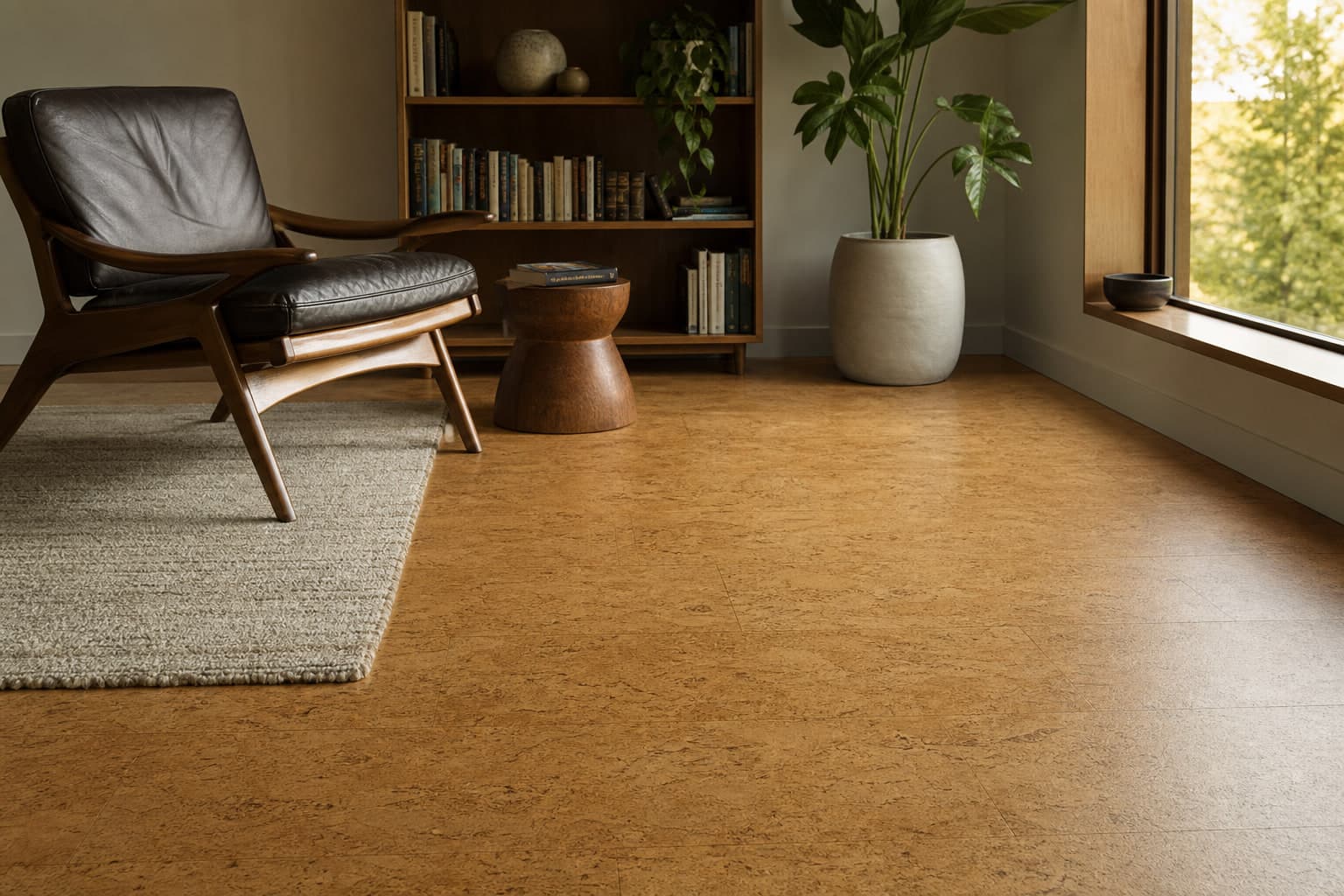
Cork offers a warm-feeling, quieter hard surface with a little give underfoot and distinctive natural character. Its finish, core, installation method, and the conditions below it determine how well it fits your home. Start with moisture, traffic, furniture, and the care you are comfortable providing, then compare colors and patterns.
01
Note the level of the home, existing floor, spills or past leaks, sunlight, and any radiant heating. These details narrow suitable cork systems.
02
Glue-down tile and floating plank can look alike while having different floor heights, moisture limits, preparation needs, and repair options.
03
Cork's slight cushioning makes it comfortable. The surface still needs grit control, furniture protection, prompt spill care, and an appropriate renewal plan.
What you are buying
Cork comes from the outer bark of the cork oak. The bark can be harvested without felling the tree and regenerates for later harvests. Flooring commonly uses granulated cork bonded and compressed into a useful, resilient material.
The finished product can also include binders, decorative veneers, a rigid core, backing, inks, and protective coatings. Ask what is in the exact tile or plank, because the cork name alone does not describe every layer or its performance.
Finished cork is designed to be walked on. Cork underlayment sits beneath another floor for support or acoustic purposes. A cork roll, bulletin-board sheet, or wall covering is not automatically suitable as an exposed floor; it needs a flooring specification, finish, and approved installation.
Further reading: Amorim on cork bark, harvesting, and regeneration.
Read the layers beneath the sample
The installation format affects the height of the floor, how it connects to the base, how it moves, and how it can be repaired. The best fit depends on the project as well as the sample you like.
Scroll across the table to compare every column.
| Format | How it is built | Useful strengths | What to check |
|---|---|---|---|
| Glue-down cork tile | Usually a through-body or mostly agglomerated cork tile, sometimes with a decorative veneer, bonded directly to the prepared substrate. | A low floor height, a stable direct bond, and flexible tile layouts. A damaged tile can often be replaced locally. | Confirm substrate and grade-level approval, adhesive, surface smoothness, and required field coats. Bathroom approval belongs to the exact system; a direct bond alone does not establish it. |
| HDF-core floating plank | A cork surface over a high-density fiberboard core, often with cork backing. Locking edges connect the pieces into a floating floor. | Convenient renovation with a resilient surface and no full-spread flooring adhesive. Some products allow installation over an approved existing hard floor. | HDF and joints can be moisture-sensitive. Check room approval, slab vapor control, added-pad restrictions, expansion clearances, and transitions. |
| Other engineered cork systems | Specialty planks or tiles can combine a cork surface with other core and backing materials. Read the layer description for the actual product. | Alternative constructions can offer different installation options, visuals, and performance characteristics to suit a particular project. | Identify the core, joint system, installation method, and written use approval. A different core does not establish waterproof performance, bathroom suitability, or permission to use extra underlayment. |
| Floor-rated cork roll / sheet | Specialty flexible cork supplied in larger sheets or rolls for a finished walking surface, with an approved adhesive and finish system. | Creates a broader, more continuous visual with fewer field seams than small tiles, depending on the room and roll dimensions. | Requires excellent smoothness, seam planning, bonding, and any specified field finishing. Ordinary cork underlayment or wall cork is not a substitute, and localized repair can be harder than with tile. |
The flooring bonds to the prepared surface. A decorative face may be part of the tile, while some tiles use a more consistent cork body. Finishing and seam treatment follow the selected system.
The planks connect to one another. A rigid core supports the locking profile; attached cork and any separate vapor-control layer have different jobs. Other engineered systems may use a different core or layer arrangement.
These diagrams explain common arrangements, not a specification for every cork floor. A cork face does not reveal whether the core is HDF, another material, or mostly cork. Confirm the actual layers, joint design, finish, and installation guide before comparing room approvals.
Further reading: Wicanders Cork Go as one example of a layered cork and HDF construction.
Natural texture and decorative choices
Cork can show a fine speckled texture, larger bark pieces, arranged veneers, stained color, or printed wood and stone designs. The face construction also determines what can be renewed later.
Scroll across the table to compare every column.
| Design choice | What you will see | What to consider |
|---|---|---|
| Natural agglomerated cork | Fine or larger granules with organic variation across the floor. | View several pieces together. Shade and texture can differ from a small sample and change with light exposure. |
| Stained cork or decorative veneer | Natural cork character with added color or an arranged bark pattern. | Confirm veneer depth, color variation, and approved recoating. A decorative face can be much thinner than the full tile. |
| Printed or embossed surface | Wood, stone, or other designs with a cork-based construction. | The image and texture can be damaged by sanding. Review the surface-maintenance and replacement options before buying. |
| Square tiles, rectangles, or planks | A modular grid, directional pattern, or longer plank rhythm. | Size changes seam count, layout, cuts, and the demands on the subfloor. Larger pieces are not a separate quality grade. |
| Square edges or bevels | Square edges blend the field; bevels outline individual pieces. | Alignment and preparation affect the finished look. More defined edges can collect soil and make seams more visible. |
Compare samples in your own daylight and evening light, alongside cabinets and neighboring floors. Review the intended laying direction, border details, and how the installer will blend natural shade variation before the first piece is installed.
Look beyond a single specification
A thicker floating plank and a thinner directly bonded tile serve different purposes. Compare similar constructions, then look at the finish, core, density, use rating, and finished floor height.
A rigid core and integrated backing add height to a floating product. A thinner glue-down tile may help at doors and adjacent floors, but thin material can show imperfections in the base. Neither thickness alone nor a large plank size proves scratch resistance, waterproofing, or commercial suitability.
Cork's small gas-filled cells allow slight compression. Density, binder, manufacturing, and the layers underneath influence support and recovery. Judge them alongside the intended loads and written product performance, rather than assuming the softest or heaviest sample will last longest.
Cork does not follow a simple vinyl-style wear-layer rule. A plank's total thickness, a cork veneer's depth, and its protective coating describe different things. Ask which specification supports the performance you need and what maintenance preserves it.
The surface you use every day
Cork provides the feel. The coating handles much of the contact with shoes, dirt, spills, chair legs, and cleaning products. Finish names and maintenance systems vary by manufacturer.
Scroll across the table to compare every column.
| Finish or system | What it offers | What to confirm |
|---|---|---|
| Polyurethane / urethane | A protective film handles everyday surface wear and makes routine cleaning practical. Some systems allow a compatible maintenance recoat before the finish wears through. | Confirm the approved cleaner, recoating process, and traffic rating. Cork's resilience does not make the finish scratch-proof. |
| Specialty factory finish | UV-cured, hot-coating, and other factory systems provide a controlled surface finish. Certain products are designed for more demanding traffic. | Compare the exact use rating and maintenance instructions. A technology name alone does not prove commercial suitability, and some factory coatings have restricted renewal methods. |
| Field-applied finish / sealer | An approved coating applied after installation can protect the installed surface and tile seams. It may be required or recommended even on a factory-finished product. | Include coating labor, drying, and full cure time in the schedule. Surface sealing does not waterproof a room or remove the flooring's moisture, core, and substrate limitations. |
| Wax system | A traditional finish with its own cleaning and restoration routine. Maintenance renews the wax protection when the product calls for it. | Choose this only with a clear understanding of its care requirements. Waxed cork and polyurethane or no-wax finishes need different products; their maintenance methods are not interchangeable. |
The protective surface is applied in controlled factory conditions. Installation may be quicker, but a coating on each piece does not automatically seal the installed seams. Confirm whether additional field coats are required, allowed, or prohibited.
An approved coating applied after installation can add protection across the installed surface and seams. Its compatibility and finishing cost belong in the product comparison.
Compare initial finishing requirements and future renewal limits before selecting a cork surface.
Warmth and a little give
Cork can feel less harsh than ceramic, stone, or other dense rigid floors. It remains a hard surface, with modest resilience rather than the plush feel of carpet.
Slight compression can make cork appealing in bedrooms, living spaces, and approved kitchens where you spend time on your feet. Compare installed samples when possible; a loose piece in your hand cannot reproduce the support, finish, and feel of the completed floor.
Cork slows heat transfer, so it often feels warmer under bare feet than tile or concrete at the same room temperature. It does not heat the room or replace building insulation. Heating performance and energy savings depend on the building and the whole floor assembly.
The same insulating quality matters when planning radiant heat. More cork or a thicker underlay is not automatically an improvement when the heating system needs to transfer warmth through the floor.
Quieter footsteps, documented performance
Cork can soften footfall and impact noise, but a quiet-feeling room and a building's acoustic requirement are different questions. For a condo or apartment, bring the written requirement before choosing a product.
Scroll across the table to compare every column.
| Sound question | What it means | What to compare |
|---|---|---|
| Footsteps and dropped objects | Impact energy can pass through the floor into the structure below. | An IIC or impact-reduction test for the specified floor, underlay, structural base, and ceiling. |
| Voices, television, and music | Airborne sound depends heavily on walls, floors, ceilings, and their connections. | Relevant STC or other required assembly data. A flooring material alone cannot solve all sound transfer. |
| A published rating | The result describes the assembly and test conditions used. | Whether the test includes a suspended ceiling, the same slab or framing, and compatible flooring layers. |
| An additional acoustic underlay | An approved layer may change the sound behavior of the system. | Flooring approval, joint support, and matching test data before adding it beneath a cork plank. |
Further reading: Amorim AcoustiCORK examples showing how sound ratings vary with the tested assembly (PDF).
Begin with how the space is used
Comfort is a strong reason to consider cork. Room approval still comes from the exact product, finish, installation method, and conditions underneath it.
Scroll across the table to compare every column.
| Room or application | Possible fit | Before you choose |
|---|---|---|
| Bedrooms and living rooms | A strong setting for cork's warm feel, quieter footsteps, and slight give. Both approved floating and glue-down products can suit these spaces. | Compare sunlight exposure, furniture feet, finish care, and final floor height. Cork remains a firm surface and will feel less plush than carpet. |
| Kitchens and dining areas | Comfort underfoot can be valuable where you stand to cook. Choose a product expressly approved for the room and expected traffic. | Compare spill exposure, chair movement, appliance loads, and any required seam sealing. A dishwasher leak can reach the core, adhesive, or subfloor even if the surface looks intact. |
| Bathrooms and laundry rooms | Some approved glue-down systems can suit bathrooms when their bonding and sealing requirements are met. Room permission varies substantially by construction. | Get the exact room approval before ordering. Floating products may exclude full baths, and ordinary cork flooring is not a shower or wet-room waterproofing system. Check laundry use separately. |
| Basements | A below-grade-approved cork system can make a conditioned basement feel more comfortable. Certain floating systems allow this use with specified vapor control. | Review slab tests, humidity, leak history, and below-grade permission. Some glue-down tiles exclude this location. A new finish floor cannot correct ongoing water intrusion. |
| Home offices and rolling traffic | Cork can provide a quieter, comfortable workspace. A suitable direct-bond system may offer useful stability for more demanding rolling loads. | Verify caster and rolling-load suitability, including mobility devices. Check mat or caster compatibility and plan low, secure transitions along frequently traveled paths. |
| Playrooms and pet households | A resilient hard surface with straightforward routine soil removal can work well in active homes when the finish and construction match the use. | Consider exposure to grit, moving toys, claws, spills, and water bowls. Comfort does not guarantee traction, prevent scratches, or keep accidents from entering seams and edges. |
| Condos and upstairs rooms | Cork can soften footfall noise and make a room sound less hard underfoot. It is worth considering when impact sound is a priority. | Obtain the building's requirement and test report for a suitable complete floor-ceiling assembly. A generic cork rating or thicker pad does not establish building approval. |
| Commercial rooms and stairs | These uses need a specifically rated product and installation detail. Commercial traffic and stair edges concentrate wear differently from a typical living room. | Confirm cleaning chemicals, rolling loads, and warranty use class for commercial rooms. Stairs need secure attachment, an approved nosing, and a review of finished tread and riser dimensions. |
For a business, request the written use classification, rolling-load approval, finish-maintenance schedule, and warranty for the actual activity. A residential product does not become suitable for a restaurant, busy public room, or equipment traffic simply because the sample feels dense.
Consider water above and below
Cork's natural moisture resistance does not make every cork floor waterproof. Liquid can reach seams, edges, coatings, cores, adhesive, and the supporting surface. Room approval and water coverage must be checked together.
An approved cork floor can offer welcome standing comfort. Plan for food spills, water bowls, appliance loads, and moving equipment for service. A dishwasher or washer leak can travel beneath the surface, so topical-spill tolerance does not establish leak or flood protection.
Some cork systems, including certain bonded and sealed tiles, are approved for bathrooms. Many HDF-core floating products have tighter restrictions. Confirm the exact room approval and perimeter details. A field coat does not make the room, shower, or subfloor a waterproof assembly.
Check below-grade approval, slab testing, vapor control, and year-round humidity. Some floating systems allow these locations with specified layers; some glue-down products restrict them. A dry-looking slab or an attractive finished basement does not establish that the conditions are suitable.
Address the source before choosing or repairing the floor. Water can remain under cork even when the face looks intact, and affected layers may need removal, drying, or replacement. New flooring and a surface coating do not correct ongoing water intrusion.
Ask what a water-related claim actually covers: a promptly cleaned spill, a defined exposure, the core, the finish, or an installed system. Then review exclusions for moisture from below, plumbing failures, standing water, and installation details.
Separate surface wear from compression
Cork can recover from some light compression, but deep, sharp, or long-lasting loads can leave permanent marks. Cork's resilience does not make the surface finish scratch-proof.
Sand at an entry, dirty chair glides, pet claws, and moving furniture can abrade or gouge the surface. These exposures affect which finish and construction suit the room.
A narrow metal foot concentrates pressure more than a broad support carrying the same load. A thin felt pad does not establish adequate load distribution for very heavy furniture. Include the required protection in the product comparison.
Bring the weight, feet or caster arrangement, and moving route into the planning discussion. Heavy point loads may need a specific protection plan and manufacturer approval.
A desk chair repeatedly crosses a small area, wearing the finish and potentially stressing the joints beneath. Check approved casters, protective chair mats, and rolling-load ratings. For heavier use, compare the stability and approval of directly bonded systems.
Do not count on every dent disappearing after you move a piece of furniture. Recovery depends on pressure, duration, density, finish, and the rest of the construction. Discuss protective measures before the floor is loaded.
Plan around daily life
A quiet, slightly resilient floor can be attractive for an active household. Match the finish and installation to the actual traffic and equipment rather than relying on a general family-friendly label.
Tracked-in grit, toys, claws, and liquid place different demands on the finish. Cork is not pet-proof or accident-proof. Compare the grip of the exact finish as well as its comfort and maintenance demands.
Review rolling-load suitability, firm support, mat compatibility, and changes in floor height. Raised thresholds or an overly soft support layer can interfere with movement. The selected product and transition design need to fit the person and equipment using the room.
Each layer has a purpose
Attached cork backing, acoustic underlay, a vapor retarder, and slab moisture treatment solve different problems.
Many floating cork floors already have an integrated backing. More soft material can increase joint movement; a thicker stack is not automatically more comfortable or better supported. Acoustic results also depend on the complete tested assembly.
Cork backing is not automatically a vapor barrier. The room, substrate, and exact product determine which moisture-control layers belong in the estimate, independently of comfort or sound features.
Plan the work with our Cork Flooring Installation service. Review installation methods and scope, then use the preparation checklist before installation day.
Comfort with the heating system
Some cork floors are approved over radiant heat. Because cork slows heat transfer, the floor, backing, underlay, and heating system need to be considered together.
Scroll across the table to compare every column.
| What to confirm | Why it matters |
|---|---|
| The exact flooring and heating type | Approval can differ for hydronic and electric systems and for different cork constructions. |
| Temperature limits and controls | Flooring, finish, core, and joints need protection from excess heat and rapid changes. |
| Total thermal resistance | The cork and all supporting layers affect how readily warmth reaches the room. |
| Rugs and furniture above the floor | Extra insulation can create localized heat buildup; check coverage and temperature guidance. |
Do not use a temperature number from another floor as a universal cork limit. Bring the heating system details to the selection discussion so the installer and heating professional can review the compatible assembly.
Natural materials change with exposure
Natural cork can lighten or mellow with age and light. Stained and printed surfaces can change differently, depending on the decorative layer and finish.
Large windows and concentrated direct sun can create more noticeable changes. Discuss window treatments and the product's exposure limits. An intensely heated, unconditioned room should be reviewed separately from a typical living space.
Covered areas may age differently from the exposed floor, leaving a visible difference when furniture or a rug moves. A saved replacement tile may also age differently in storage.
Cleaning, protection, and upkeep guidance is in our dedicated Cork Care & Maintenance guide.
Compare around your priorities
Think about standing comfort, spills, furniture, desired appearance, and future care together. Each category contains different constructions and performance levels.
Scroll across the table to compare every column.
| Comparison | Where cork may appeal | Tradeoff to weigh |
|---|---|---|
| Cork compared with hardwood | Cork often feels more cushioned and quieter underfoot, with a distinctive bark pattern rather than a lumber grain. | Compare finish protection and renewal separately. A cork veneer or printed surface cannot be assumed to tolerate the sanding possible with a suitable hardwood floor. |
| Cork compared with laminate | Cork's cellular structure can provide a warmer, more forgiving feel than a rigid laminate surface. | Compare actual surface wear, moisture approval, and core construction. Both floating installations need proper support and room to move; a cork surface does not remove those requirements. |
| Cork compared with luxury vinyl | Cork offers renewable bark content and often a warmer, more resilient feel, especially when a natural cork visual is part of the appeal. | Review room and water coverage for each exact product. Cork needs finish protection and may need future recoating; vinyl-style wear-layer measurements do not provide an equivalent cork quality grade. |
| Cork compared with tile or stone | Cork usually feels warmer to bare feet and less harsh when standing because it slows heat transfer and compresses slightly. | That resilience also makes concentrated furniture loads a concern. Check surface protection, moisture limits, and radiant-heat design instead of expecting cork to behave like a dense mineral floor. |
| Cork compared with carpet | Cork provides a firm finished surface with some give and accessible routine removal of loose hair and grit. | It is less plush than carpet. Compare the comfort you want with finish maintenance, sound requirements, and the way furniture or rolling equipment will use the room. |
Explore the Hardwood, Laminate, Luxury Vinyl, Tile, and Carpet guides to compare the construction and room suitability behind each choice.
Look at the complete product
Cork's regrowing bark is a useful raw-material advantage. The environmental and indoor-air profile of a finished floor also depends on its core, binders, coatings, adhesives, production, service life, and disposal.
Scroll across the table to compare every column.
| Document or claim | What it can help explain | What to confirm |
|---|---|---|
| An emissions certification | A defined product's performance under an indoor-air emissions program. | The exact product and current certification scope. Flooring approval does not automatically include a site-applied adhesive or coating. |
| Environmental Product Declaration | Reported impacts across the life-cycle stages defined in the document. | Product scope, assumptions, and comparable methods. An EPD alone is not a promise of zero impact or carbon neutrality. |
| Ingredient or material disclosure | The components used in the finished flooring. | Whether it covers the core, binders, finishes, and other layers you are comparing. |
| Recycled content, PVC-free, or carbon claim | A specific attribute that may matter to your selection. | The defined product, percentage or boundary, and supporting evidence rather than a claim for cork in general. |
| End-of-life options | Possible recovery, reuse, or disposal routes for the actual floor. | Whether coatings, binders, cores, adhesives, and local facilities allow the stated route. |
A natural starting material does not make a manufactured floor chemical-free, universally low-emitting, or automatically biodegradable. If emissions are a priority, compare the flooring and all installation products. Suitable durability, maintenance, and renewal also affect how often a floor needs replacement.
Understand the full project
Preparation, installation layers, finishing, trim, and future care can change the total cost substantially. Ask what is included so quotes describe comparable work.
Scroll across the table to compare every column.
| Part of the decision | What to confirm | Why it matters |
|---|---|---|
| Flooring quantity | Measured area, layout waste, borders, carton quantities, lot blending, and repair stock. | There is no universal waste percentage. Room shape, format, and the planned pattern affect the order. |
| Preparation and moisture | Removal, testing, patching, smoothing, structural concerns, and approved moisture control. | A material-only comparison can omit the work that makes the floor perform. |
| Installation and finishing | Adhesive or vapor layers, any approved underlay, required coatings, labor, and cure schedule. | Different cork systems include different products and return-to-use times. |
| Edges and access | Transitions, base trim, stair details, door clearance, delivery, and furniture or appliance handling. | These can affect cost, usability, and the sequence of the project. |
| Warranty coverage | Eligible rooms and traffic; finish wear, structure, water, sunlight, scratches, dents, and installation exclusions. | A long term covers defined failures under specified conditions, not an unchanged appearance. |
| Remedy and records | Material and labor coverage, prorating, claim steps, and required care or installation documentation. | Know how a covered issue would be assessed and resolved before you order. |
Keep the written scope, product labels, moisture-test and preparation records where available, installation details, and maintenance information. Ask about ordering lead time, available accessories, and return terms for special-order material.
Take this to the showroom
Photos, a rough layout, the existing floor, and details of leaks, heating, sunlight, or building requirements make the product comparison more useful. You do not need a finished installation plan to start.
Discuss your cork projectCommon buying questions
Open a question for a quick answer. Use the selected product's installation, care, and warranty documents to confirm the details for your project.
Cork comes from the outer bark of the cork oak, which can regrow after harvesting without felling the tree. Flooring commonly uses granulated cork bonded into tiles or layers. The finished product may also contain a decorative veneer, rigid core, backing, binders, and protective coatings, so its complete construction matters.
No. Finished cork flooring is designed and protected to be the surface you walk on. Cork underlayment belongs beneath another approved floor and has a different purpose. Cork wall sheets are also separate products. Use a roll or sheet as a walking surface only when it is expressly floor-rated.
Glue-down tile offers a lower profile and direct bond but requires a very smooth substrate, approved adhesive, and any specified field finishing. Floating planks can simplify renovation but need flat support, expansion space, and product-specific moisture protection. Choose from the room, floor height, subfloor, traffic, and written use approvals.
Do not treat cork flooring as a universally waterproof category. Cork material has moisture resistance, but the installed floor also includes seams, finish, adhesive, and sometimes a moisture-sensitive core. Read the exact water coverage and room approval. Even a water-resistant surface does not waterproof the subfloor, plumbing penetrations, or surrounding room.
Only when the exact product permits that room. Cork can be comfortable in a kitchen; some bonded and sealed systems are approved for full bathrooms. Many floating products have stricter wet-area limits. Confirm laundry use separately, check required perimeter details, and consider possible appliance leaks.
Some systems allow these locations, but approval varies by construction and grade level. Concrete needs the manufacturer's required moisture testing even when it looks dry. Review the floor and adhesive limits, approved vapor or moisture-control layers, and any history of leaks. Cork cannot fix an ongoing basement water problem.
Many floating cork planks already have backing; extra soft pad may damage their support and joints. Attached cork is not automatically a vapor retarder, so moisture control remains a separate decision.
No. Total thickness affects floor height, construction, feel, and transitions, but does not establish scratch resistance or water approval. Compare similar constructions and check the finish, density, decorative surface, core, and use rating. A thicker plank still needs a substrate that meets its flatness requirements.
Cork can recover from some minor compression, but concentrated or prolonged weight can leave permanent dents. Scratches mainly involve the protective finish, which still needs protection from grit, claws, and dragging.
It can be, when the product and installation suit the actual use. Pets bring claws, grit, and accidents; rolling equipment repeatedly loads the same paths. Check finish and rolling-load approval, approved casters or mats, stable transitions, and cleanup requirements. Cork's comfort does not make it scratch-proof, slip-proof, or accident-proof.
Cork can reduce impact noise, but compliance depends on the complete tested floor-ceiling assembly and the building's requirement. Ask for matching test documentation, including the structure, ceiling, and underlayment involved. Impact-noise results do not establish the same performance against voices or music, and thickness alone does not prove a rating.
Cork slows heat transfer, so it often feels warmer to bare feet than tile or stone. It does not generate heat. Some products allow radiant heating; verify the heating type, total thermal resistance, temperature limits, and startup procedure. Rugs or extra pad can add insulation and affect localized heat buildup.
It can. Natural cork often lightens with exposure, while stained or printed products may age differently. Areas under rugs and furniture can remain a different shade. Expect some natural change and read the product's color-change warranty terms before choosing.
Some cork can be renewed, but recoating and sanding are different processes. A compatible maintenance recoat may preserve protection before the surface is worn through. Thin veneers, printed designs, textured surfaces, and specialized coatings can restrict sanding or recoating. Compare the written renewal limits before purchasing.
Often, depending on the construction and damage. A bonded tile may be removed locally; a floating plank may require disassembly or an approved cut-in repair. Moisture damage can involve more than the visible piece. Include repair stock in the purchase; age and light exposure can affect the eventual match.
Renewable bark is a material benefit, but the complete floor also has binders, finishes, and possibly other core materials. Check current documentation for the exact product and any installation adhesive. Emissions certification, ingredient disclosure, recycled content, and life-cycle environmental data answer different questions; natural cork alone does not establish those claims.
Include flooring, layout waste, spare pieces, removal, substrate preparation, moisture control, adhesive or underlayment, finish coats, trim, labor, and curing time as applicable. Read warranty coverage separately for finish wear, structure, rooms, water, and commercial use, including exclusions and labor remedies. Keep product, installation, and care records.
Your next step
Talk with Floors Now in Newington about current cork options, the feel and look you want, and what the installation would involve. We can help you compare the construction, finish, and preparation questions that matter to your space.
Reviewed by Floors Now
This customer guide draws on Floors Now cork flooring product material, with supporting references from Wicanders, Globus Cork, and Amorim linked beside relevant topics. Manufacturer examples explain product differences; they do not establish current showroom inventory or transfer one product's approvals to another.
The hero photograph is room inspiration. Construction diagrams simplify common layer arrangements and are not to scale. The exact flooring, adhesive, coating, underlay, and heating-system instructions, together with project conditions and warranty terms, determine the final specification.
Back to topYour cork flooring project
Share your existing flooring, daily traffic, sunlight, and any moisture, heating, or sound concerns. We can help you compare cork options and plan the next steps. You can also visit our Newington showroom.