01
Describe the activity
List the traffic, equipment, weights, wheels, footwear, and spills the room will see. Cardio, heavy lifting, and a commercial hallway may need different rubber systems.
Newington showroom • Serving Connecticut

Rubber flooring product guide
Match the floor to the way you move, work, and use equipment. Compare rubber rolls and tiles, understand comfort and performance limits, and choose for the room’s moisture and equipment loads.
Request a free rubber flooring estimate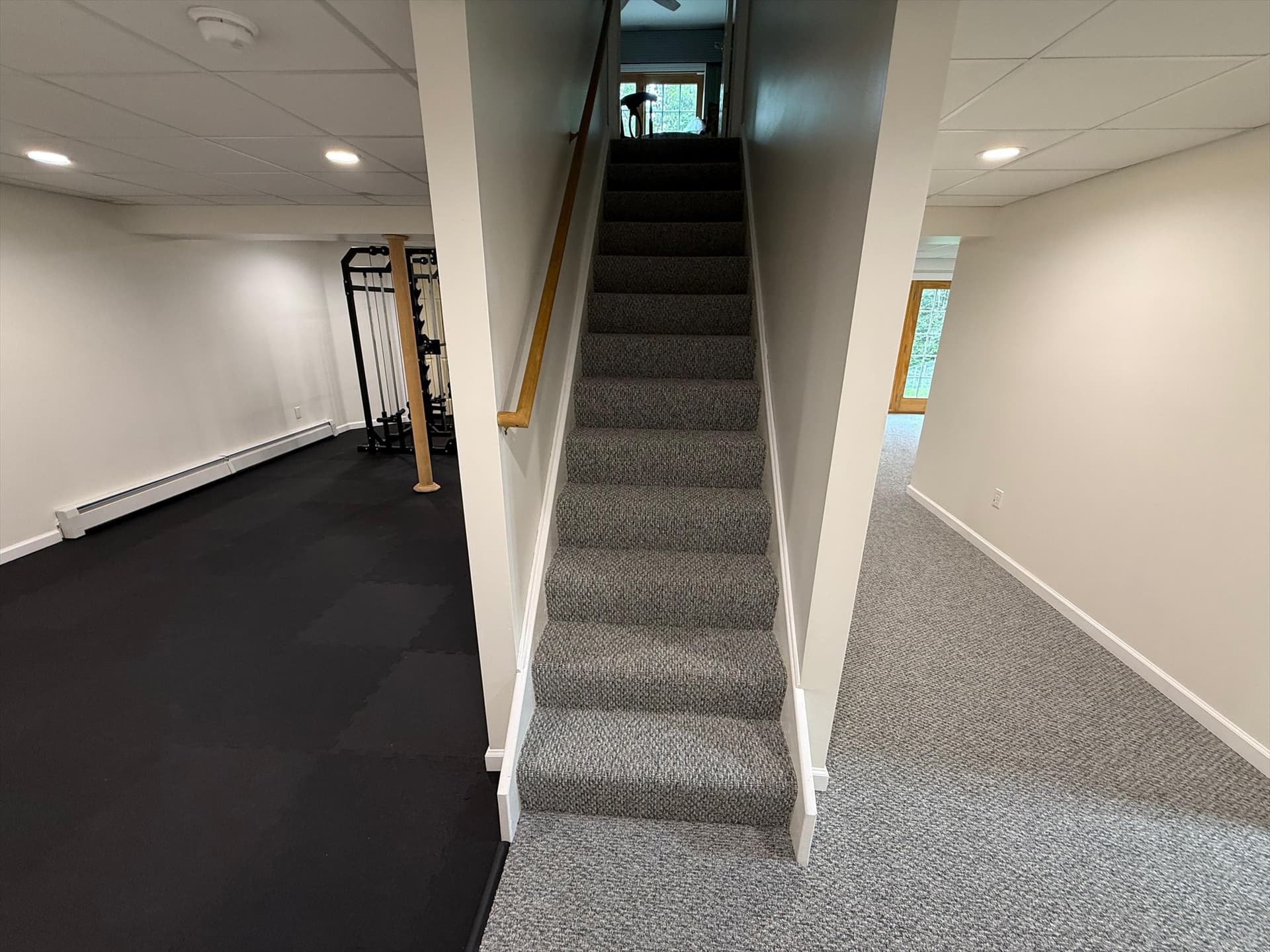
Rubber can provide a durable, resilient surface for a home gym, a busy corridor, or a specialized workspace. The right product depends on more than color or thickness: footsteps, equipment feet, turning wheels, dropped weights, liquids, and cleaning all place different demands on it.
01
List the traffic, equipment, weights, wheels, footwear, and spills the room will see. Cardio, heavy lifting, and a commercial hallway may need different rubber systems.
02
Identify the existing floor, slab moisture, access, neighboring rooms, and sound requirements. Water resistance in the rubber does not remove these installation questions.
03
Compare seams, adhesive, transitions, cleaning, and future replacement along with the material price. The full system determines how the room works over time.
Two common starting points
Both can be resilient and durable, but their construction and priorities often differ. Identify the product family before comparing samples or choosing a thickness.
Commercial sheet and tile are often made from a vulcanized compound cured under heat and pressure. A relatively dense surface can support heavy foot traffic, rolling equipment, and regular commercial cleaning when the product is approved for that use. Some products are homogeneous; others have backing or specialized layers.
Many gym products use rubber granules held together with a binder, often polyurethane. Rolls, interlocking tiles, and thicker impact systems can balance cushioning, traction, and equipment demands. Their granular surface may be porous, and their cleaning and impact behavior differ from dense commercial sheet.
A thin commercial floor can be highly capable in a corridor while being unsuitable for heavy weight drops. A thick gym tile can manage impact without being the best surface for hospital beds or frequent disinfection. Backed, layered, ESD, and other specialty constructions need their own review.
Material origin is one part of the specification
Finished flooring can contain rubber, fillers, pigments, binders, and other ingredients. The formulation influences feel, appearance, odor, chemical resistance, and the uses the manufacturer approves.
Scroll across the table to compare every column.
| Material family | What it means | Useful characteristics | What to check |
|---|---|---|---|
| Natural rubber | Rubber derived from latex harvested from rubber trees. It can be an ingredient in a finished commercial flooring compound. | Contributes elasticity and resilience to a formulated floor. Its performance depends on the other ingredients, curing process, and finished construction. | Natural rubber content does not mean the flooring is entirely natural or establish an allergy claim. Request product-specific ingredient and testing documentation where material sensitivities matter. |
| Synthetic rubber | Manufactured elastomers such as SBR or EPDM, used in commercial flooring, athletic surfaces, colored granules, and specialty compounds. | Different formulations can support particular color, wear, weathering, or chemical-resistance goals. Synthetic rubber is a broad material family with many possible uses. | The ingredient name does not establish indoor/outdoor approval, oil resistance, or impact protection. Compare the complete product's published performance and approved application. |
| Recycled rubber | Recovered rubber, often tire-derived SBR, commonly processed into granules and held together with a binder for athletic flooring. | Often used for fitness surfaces, cushioning, vibration control, and impact layers. Colored flecks can create a practical visual for active spaces. | Texture, porosity, odor, and impact performance vary. Confirm cleanability, emissions documentation, floor compatibility, and the specific activity rating; recycled content alone does not establish those qualities. |
| Blended rubber compound | A combination of rubber ingredients, fillers, pigments, and other additives engineered into a finished flooring product. | Common in dense commercial sheet and tile, where the formulation balances traffic resistance, resilience, appearance, and maintenance requirements. | Assess the tested floor as a whole. A proprietary recipe may include natural and synthetic rubber without giving either ingredient a simple quality ranking. Read the construction and use rating alongside the composition. |
Words such as natural, recycled, or synthetic are not quality grades. Compare the complete product and its test data. In particular, recycled content does not by itself establish low emissions, and a natural-rubber ingredient does not mean the finished floor contains only natural materials.
Seams, fitting, and future repairs
Format changes the layout, the number of joints, installation labor, and how a damaged area can be replaced. It also affects how large or heavy the material is to handle.
Scroll across the table to compare every column.
| Format | Where to consider it | Useful strengths | Planning points |
|---|---|---|---|
| Commercial sheet | Corridors, healthcare, and other approved commercial spaces that benefit from a broad, continuous cleaning surface. | Fewer seams than small tiles, with approved systems offering wall-cove details for particular hygiene or maintenance requirements. | Sheet still has seams. Fitting, substrate smoothness, adhesive, and any welding or cove work affect installation cost. A future patch can remain visible, so discuss repair expectations before choosing the format. |
| Commercial tile | Schools, offices, public circulation areas, and commercial rooms where modular layouts and localized replacement are useful. | Allows color blocking and controlled layouts. Individual damaged tiles can often be replaced without replacing a large sheet section. | There are more joints to plan and maintain. Accurate alignment, substrate preparation, and the approved adhesive still matter. A newer replacement may differ from an aged floor. |
| Athletic roll | Fitness studios, cardio areas, and weight rooms when the exact thickness and construction suit the activity. | Covers larger exercise areas with fewer joints than small athletic tiles and can provide a consistent surface around equipment. | Rolls can be heavy and need conditioning, seam planning, and the specified bond or restraint. General fitness roll is not automatically suitable for heavy dropped weights or a gym above occupied rooms. |
| Interlocking fitness tile | Home gyms, smaller exercise spaces, and selected movable or temporary installations where the product allows that use. | Modular pieces simplify handling and replacement. Some approved systems can be installed without a full spread of wet adhesive. | Confirm room-size limits, perimeter treatment, movement allowances, and equipment restrictions. Interlocking joints do not seal against water. Loose placement also does not guarantee compatibility with hardwood or another finished floor underneath. |
| Thick impact tile / layered system | Designated free-weight and lifting areas with more demanding impact, bounce, or vibration requirements. | Can combine a durable top with an impact layer or platform to manage the forces from the intended training program. | Specify actual weights, drop heights, frequency, equipment feet, structure, and sound goals. Include edge ramps and door clearances. Thickness alone does not guarantee slab protection, quietness, or suitability for every drop. |
Interlocking does not automatically mean unrestricted loose lay. Some systems need adhesive, perimeter restraint, specific room-size limits, or additional measures for wheels and heavy equipment. Likewise, sheet reduces seams but does not eliminate them.
Match the specification to the job
Low-profile commercial floors and thick athletic systems use rubber differently. Extra thickness can add cushioning and height without solving a particular chemical, load, or sound requirement.
Scroll across the table to compare every column.
| Specification | What it describes | How to use it |
|---|---|---|
| Thickness and layer construction | The depth of the floor, including any wear body, backing, or impact layer. | Compare similar systems. Check the installed height, equipment support, impact testing, and transitions together. |
| Density and hardness | How much material occupies a volume and how firmly the surface resists deformation. | A firmer surface may help rolling stability; a softer one may suit another activity. Neither alone establishes overall quality. |
| Resilience and compression set | How the material deforms, recovers, and retains an impression after loading. | Review the actual static loads, contact areas, and expected recovery rather than assuming every dent disappears. |
| Force reduction and energy return | How a sports surface manages impact and returns energy during activity. | Match the balance to movement, stability, and the activity. The softest surface or highest single result is not automatically the best choice. |
| Homogeneous or layered wear construction | Whether the usable body is consistent through its thickness or has distinct layers. | Through-color material can reduce the contrast of some wear, but does not make cuts, gouges, or stains invisible. |
Further reading: Ecore on force reduction, energy return, and activity-specific surface design.
Think about the dirt the room will see
Solid colors, flecks, marbling, and raised profiles can change the feel of a room and how readily everyday marks show. They also influence cleaning and rolling behavior.
Scroll across the table to compare every column.
| Surface or visual | Why it may appeal | What to weigh |
|---|---|---|
| Smooth or lightly textured | A cleaner visual and relatively easy contact for cleaning tools and wheels. | Soil and scuffs can be more visible depending on color and light. Review tested traction for the actual conditions. |
| Hammered or subtle texture | Visual depth that can help disguise minor wear and traffic patterns. | The cleaning method must reach the texture rather than leave residue around it. |
| Stud, coin, or raised profile | A recognizable rubber-floor appearance and a defined surface pattern. | Small wheels and mop contact can be affected. More visible texture does not prove better slip performance. |
| Solid color | An architectural, consistent field. | Dark floors can show pale chalk, dust, and salt; light colors can emphasize dark transfer marks. |
| Flecks, chips, or marbling | Variation that can soften the appearance of everyday dirt and small marks. | Check production lots, pattern direction, and natural visual differences between pieces. |
| Granular athletic surface | A familiar gym look, often with colored flecks in a darker base. | Dust, chalk, sweat, and oils need a cleaning plan suited to the texture and porosity. |
Review more than one sample or piece when possible. Fleck content and color can affect price and appearance, but they do not replace the product's traffic, load, or impact rating. Approve the direction and blending plan before installation.
Three different demands
A floor's ability to handle footsteps does not establish that it can support a loaded rack, a turning cart, or a dropped barbell. Describe each demand separately when planning the room.
Racks, machines, and furniture concentrate weight at their feet. Total weight, contact area, duration, and approved load spreaders affect indentation.
Casters add repeated movement and turning forces. Wheel width, diameter, hardness, equipment weight, and the adhesive system all matter.
Impact depends on weight, drop height, frequency, contact shape, and the base below. The floor or platform must be designed for those conditions.
Bring equipment specifications rather than just a total room weight. Broad feet and narrow metal points apply very different pressure. A static-load result is not permission for forklifts, metal casters, skate blades, or repeated heavy drops.
Design around the workout
Cardio, classes, strength machines, and free weights create different demands. A useful plan balances traction and comfort with stable movement, equipment support, cleaning, and impact management.
Scroll across the table to compare every column.
| Activity | Main needs | Details to bring |
|---|---|---|
| Cardio and spin | Equipment support, vibration management, traction, and routine sweat cleanup. | Machine weights and feet, movement or service routes, footwear, and adjacent occupied rooms. |
| Group exercise and functional training | Stable footing with suitable force reduction and energy return. | Types of movement, body contact, equipment, whether drops occur, and the cleaning schedule. |
| Selectorized machines and racks | Support for concentrated static loads and protected equipment movement. | Weight per support, foot dimensions, anchoring requirements, and access for assembly. |
| Dumbbells and free weights | Repeated localized impact, surface durability, and predictable response. | Maximum weights, shapes, expected drop heights and frequency, and the substrate. |
| Olympic lifting and demanding drop zones | A designed floor or platform system managing impact, bounce, and vibration. | The lifting program, structure below, neighboring spaces, and product-specific impact and acoustic evidence. |
There is no single roll thickness that protects every slab from every weight. A lifting platform or multilayer drop-zone system may be appropriate. Review the flooring with the equipment plan and obtain structural input where required; a rubber covering cannot establish the building's load capacity.
Different systems can create different finished heights. Include compatible ramps, reducers, door clearances, and movement routes from the beginning. A raised impact area should fit how people and equipment actually cross the room.
From home gyms to commercial spaces
Choose the exact construction for the actual use. The same building may contain several rooms with different needs for water, chemicals, cleaning, rolling equipment, and impact.
Scroll across the table to compare every column.
| Application | Possible direction | Before choosing |
|---|---|---|
| Home gym and cardio room | Fitness roll or interlocking tile can provide a resilient, practical surface around treadmills, bikes, and exercise equipment. | Review odor expectations, equipment feet, cleaning, edge ramps, and the finish beneath the rubber. Identify whether any weights will be dropped; that changes the selection. A loose mat can still trap moisture or discolor an incompatible floor. |
| Basement gym or hobby room | An approved rubber system can suit below-grade spaces after the slab and moisture conditions have been evaluated. | A dry-looking slab is not a moisture test. Resolve water intrusion and confirm the flooring, adhesive, and any moisture-control treatment together. Water-resistant rubber does not prevent moisture or odor from becoming trapped underneath. |
| Group exercise and fitness studio | Activity-rated rubber can balance stable footing, resilience, traction, and routine sweat and soil removal. | Describe the classes, footwear, turning movements, and equipment. Stretching, spin, and active group classes may need different surface behavior. Excessive softness is not always helpful, and chalk, sweat, or cleaner residue can reduce traction. |
| Free-weight room and lifting zone | Performance rubber, approved impact layers, and designed platforms can address repeated localized drops and heavy racks. | Provide the lifting program, weight and drop information, rack contact points, and rooms below or beside the gym. Structural protection and low-frequency vibration may require a designed assembly; a general footfall sound rating does not settle those questions. |
| Healthcare, clinics, and laboratories | Dense commercial rubber can combine rolling performance, resilience, and a surface suited to an approved cleaning program. | Verify beds and casters, disinfectants and dwell times, seams, coving, emissions requirements, and any static-control specification. Cleanability does not establish antimicrobial performance. Technical areas may need specialty systems beyond an ordinary commercial floor. |
| Schools, offices, and public corridors | Commercial sheet or tile can handle an approved mix of foot traffic, chair movement, and routine maintenance with a quieter feel underfoot. | Check the actual traffic and rolling loads, chair-foot protection, entry soil, and care schedule. Plan stairs with factory stair products. Cafeterias, laboratories, and adjacent weight rooms may need different products from the corridor. |
| Commercial kitchens and food service | Consider only a system explicitly approved for the fats, oils, wet conditions, cleaning chemistry, and sanitation demands of the space. | Standard rubber can swell, soften, or stain under unsuitable chemical exposure. Confirm heat, drains, seam treatment, traction, and cart loads as well as the compound. A textured surface alone does not establish kitchen suitability. |
| Garages, workshops, and industrial areas | Specialty products may suit particular industrial uses when their chemical, tire-contact, and load approvals match the site. | List oils, fuels, lubricants, tires, sharp debris, hot work, and equipment. Forklift turning is different from walking traffic. Many indoor rubber products are unsuitable for these exposures or for temperature and sunlight changes at open doors. |
| Electronics and raised-access spaces | A specified ESD system can control static where required. Module-compatible rubber may also be used on designed access-floor panels. | Coordinate electrical requirements, approved bonding, professional grounding and verification, panel dimensions, removability, and rolling equipment. Ordinary rubber is not automatically static dissipative or conductive, and cutting generic tile to panel size does not establish system approval. |
A heavy-commercial label is not a blanket approval for every demanding space. If the project involves specialized cleaning, food grease, sharp footwear, industrial vehicles, or static control, bring those requirements into the product discussion before ordering.
Resilience, grip, and everyday movement
Rubber can feel more forgiving than concrete, ceramic, or other hard mineral surfaces. Comfort still depends on the complete construction, the activity, and the way the room is used.
A resilient surface can reduce the feeling of hardness underfoot. A specific anti-fatigue requirement calls for a product designed and evaluated for that purpose. A general rubber floor is not automatically equivalent to an ergonomic standing mat.
Water, sweat, chalk, oils, dirt, footwear, and slope can change grip. No floor is slip-proof. Compare relevant test information and plan contaminant removal; selecting the most raised texture is not a substitute for evidence or regular cleaning.
A softer or more aggressive surface may increase rolling effort. Consider casters, walkers, wheelchairs, transition profiles, and firm support together. Review the actual equipment and route rather than assuming additional cushion always improves access.
Skates, spikes, and cleats can cut or tear a product that tolerates ordinary shoes. Those activities need an expressly approved extreme-wear surface. They are a separate demand from general abrasion or foot traffic.
Footsteps and weight drops are different sounds
Rubber can soften impact noise and vibration. The final result also depends on the structure, ceiling, supporting layers, installation, and how impact reaches surrounding spaces.
Scroll across the table to compare every column.
| Question | What to understand | What to request |
|---|---|---|
| Will footsteps be quieter downstairs? | IIC and related impact measurements describe a tested floor-ceiling assembly. | A relevant report with the actual product, support layers, slab or framing, and ceiling conditions. |
| Will voices and music be quieter? | Airborne sound is different from impact sound; walls and structural connections also matter. | The building's sound criteria and appropriate assembly data, rather than substituting a footfall rating. |
| Will dropped weights disturb nearby rooms? | Heavy impacts create low-frequency thumps and vibration that a standard footfall rating may not describe. | Weight-drop or heavyweight-impact evidence relevant to the proposed activity and assembly. |
| Can extra underlay solve the problem? | Added cushioning can change support, rolling resistance, seams, and impact response. | An approved complete system, with acoustic advice when occupied rooms are below or alongside the activity. |
Provide the building's written sound requirement before selecting a floor. A rating from a brochure is useful only when its test conditions are understood; it is not a guarantee of soundproofing or approval in a different building.
Further reading: Ecore on flooring acoustics and heavyweight impact sound.
Name the actual exposure
Chemical resistance depends on the compound and the substance, concentration, temperature, and contact time. A broad resistance claim does not mean that every cleaner or spill is acceptable.
Bring the actual cleaning and disinfectant products, dilution, and dwell times. The selected rubber, seams, and adhesive must fit the facility's cleaning plan. A cleanable floor does not justify an unsupported claim that it kills germs or replaces infection-control procedures.
Fats, cooking oils, hot liquids, degreasers, wet conditions, and carts can act together. Standard rubber may swell, soften, or stain in these conditions. Consider only a system expressly approved for the particular grease, temperature, sanitation, and rolling demands.
Tires, petroleum products, hydraulic fluids, metal debris, turning vehicles, and heat are separate exposure questions. Ordinary indoor gym or corridor flooring may be excluded. Verify tire contact, load and shear limits, chemical compatibility, and indoor or outdoor exposure.
Dyes, iodine, solvents, and aggressive cleaners can permanently alter some rubber surfaces. Bring expected chemical exposures into the selection so compatibility can be confirmed for the complete system.
Further reading: Flexco Repel as an example of a specialized formulation with defined grease and heat limitations.
When static control is a project requirement
Ordinary rubber is not automatically an electrostatic-discharge floor. Static-dissipative, conductive, antistatic, and insulating claims describe different functions and should not be treated as interchangeable.
Provide the required electrical performance and the environment where the floor will be used. The specified flooring must work with the facility's equipment, footwear, cleaning, and static-control program. Insulating protection is a different function from providing a controlled path for charge.
An ESD requirement changes the installation scope, supporting components, and verification cost. A general antistatic label or a different tile color does not establish the specified performance.
Comfort includes the indoor environment
Rubber formulations vary, and the installation also includes adhesives and care products. Evaluate the exact materials rather than assuming that every rubber floor has the same odor or certification.
Some recycled athletic products have a noticeable rubber odor. Perceived odor is not a measurement of emissions, and a low-emissions certification does not promise an odor-free experience. Discuss samples, ventilation, intended occupancy, and sensitivity requirements before choosing.
Request current emissions certifications and ingredient or testing information for the actual product. Include installation and cleaning materials in the review. Do not infer a universal latex or material-sensitivity claim from the words natural, synthetic, or recycled.
Commercial projects may require particular fire or smoke test results. Match the exact product report to the project requirements, including any different rules for stairs or other uses. A tested classification does not mean the floor is fireproof.
Hot equipment, sparks, intense exposure, and temperature changes can affect rubber or its bond. Check product-specific limits and indoor or outdoor approval. If underfloor heating is present, obtain approval for the flooring, adhesive, and heating assembly together.
Further reading: UL GREENGUARD on measured emissions and why odor alone is not an emissions test.
Water above and moisture below
The installed floor includes seams, perimeter details, adhesive, and a supporting surface. A granular athletic product may also allow water through its structure, depending on its design.
Liquid can enter seams or travel around edges even when the rubber itself tolerates moisture. A no-glue installation does not protect the base from trapped water.
Concrete can release vapor and alkalinity while looking dry. Follow the specified testing and limits for both flooring and adhesive, including grade-level approval. Moisture mitigation must match the measured conditions and the installation system.
Do not assume a rubber covering, interlocking joint, or welded seam creates a waterproof room. Use a system expressly approved for the wet environment, with the required drainage and detailing. Traction and cleaning still need separate consideration.
Even if the rubber remains intact, contamination, adhesive damage, and the need to dry the base can require removal. Address active water intrusion before installation or replacement. A high-moisture adhesive does not repair a leak or make a damp room ready for flooring.
Plan the work with our Rubber Flooring Installation service. Review installation methods and scope, then use the preparation checklist before installation day.
Know which job each layer performs
Rubber may be the walking surface, part of the flooring's backing, or a separate layer beneath another material. Those products and roles are not interchangeable.
A roll intended as acoustic underlayment does not automatically have the wear surface or approval for exposed use. A backed commercial sheet may need a different adhesive or supporting system from an unbacked product with a similar appearance.
Additional soft layers can increase indentation, rolling effort, movement, or seam stress. Impact bases and sound layers belong in an approved assembly with a suitable top surface. Stacking spare mats is not equivalent to a designed acoustic or lifting system.
Cleaning, protection, and upkeep guidance is in our dedicated Rubber Care & Maintenance guide.
Look beyond a single ingredient
Recycled content can be one benefit of a rubber floor. Durability, maintenance, manufacturing, indoor emissions, repairability, and end-of-life options also affect the overall decision.
Scroll across the table to compare every column.
| Document or claim | What it helps explain | What it does not establish by itself |
|---|---|---|
| Recycled content | The amount and type of recovered material used in the defined product. | Low emissions, a particular service life, or suitability for every room. |
| An emissions certification | Performance against the defined program's indoor-air emission criteria. | Zero odor, universal material-sensitivity suitability, or approval of all installation and care products. |
| Environmental Product Declaration | Reported life-cycle impacts within the document's scope and assumptions. | An automatic ranking above another floor with a different scope or method. |
| Ingredient or health-product disclosure | Information about the components in the covered product. | A durability rating or a simple conclusion that every listed ingredient creates the same exposure. |
| A product sustainability certification | Assessment against the named program and criteria. | Coverage for every product made by the same brand. |
| Take-back or recycling program | A possible end-of-life route under the program's conditions. | Guaranteed local acceptance of installed material, adhesive-contaminated pieces, or every type of rubber. |
Request current documents for the exact product and include adhesives, specialty treatments, and the intended maintenance program in the comparison. A long-lasting, maintainable floor can offer value that a recycled-content percentage alone cannot describe.
Compare the whole project
The installation system, preparation, seams, transitions, and activity-specific details can change the cost substantially. Ask for comparable scopes before comparing the final price.
Scroll across the table to compare every column.
| Part of the purchase | What to include or confirm | Why it matters |
|---|---|---|
| Flooring and layout | Measured area, cuts, roll or tile layout, color and lot control, special colors, and repair stock. | Format and pattern affect waste; one percentage is not appropriate for every project. |
| Preparation and moisture | Removal, testing, repairs, smoothing, contamination treatment, and any compatible mitigation. | A low material price may exclude essential work beneath the surface. |
| Installation and seams | The selected adhesive or dry system, seam cutting, welding or joint treatment, cove work, and curing time. | Different formats can require very different labor and downtime. |
| Edges, stairs, and access | Ramps, reducers, door clearances, treads, risers, nosing support, and any access-panel coordination. | Accessories affect usability, safety, finished height, and the completeness of the job. |
| Special performance | Impact zones, platforms, acoustic layers, ESD components, professional coordination, and required testing. | These are complete system requirements, not just alternate surface colors. |
| Handoff and future care | Equipment moving, construction protection, initial cleaning, written maintenance, and replacement options. | These affect the first day of use and the effort of ownership. |
| Warranty terms | Approved use, loads, moisture, chemicals, installation, cleaning, exclusions, labor coverage, and remedy. | A long term covers defined failures and conditions; it does not promise an unchanged floor in every application. |
Keep the scope, product labels, batch information, relevant test and installation records, maintenance guide, and warranty. Confirm delivery access, lead times, and special-order or return terms before committing to a layout.
Take this to the showroom
Photos, measurements, equipment information, and any building requirements help narrow the right rubber system. Include what is underneath, what may spill, and how the room will be cleaned.
Discuss your rubber projectCommon buying questions
Open a question for a quick answer. The selected product's installation, maintenance, test reports, and warranty determine the details for your project.
No. Dense commercial sheet and tile, bound-granule athletic rolls, interlocking gym tiles, impact systems, and specialty ESD products serve different purposes. Compare construction, approved use, loads, cleaning, and installation as well as color and thickness.
Rubber material often resists water well, but the installed floor includes joints, edges, adhesive, and a substrate. Some athletic products are porous. Spills, flooding, and slab moisture need separate consideration; rubber flooring alone does not waterproof a room.
Choose it around the activity, equipment, weight drops, substrate, and sound requirements. Cardio, group exercise, and heavy lifting can need different constructions. Compare thickness within similar systems and request approval for the intended use rather than relying on one universal measurement.
The right impact system can reduce transmitted force, but protection depends on weight, drop height, frequency, equipment shape, and the structure below. Heavy lifting may need a designed platform or multilayer drop zone. General commercial rubber or a thin gym mat is not a universal safeguard.
Products vary. Some recycled athletic rubber has a recognizable odor, while other formulations have a much lower odor. Review a sample and product documentation before ordering. Odor is separate from measured emissions, so use current product-specific emissions certifications for indoor-air requirements.
Yes, when the exact product and installation system are approved for the conditions. The slab still needs evaluation and the specified moisture testing. Resolve water intrusion first; neither loose-laid rubber nor a high-moisture adhesive automatically prevents moisture problems beneath the floor.
Only with confirmed compatibility for both surfaces and the installation method. Rubber contact can discolor some finishes, and covered areas can trap moisture. An approved protective system may be needed. Do not assume a generic barrier, loose mat, or existing floor is suitable.
Some systems allow installation without full-spread adhesive; others require restraint or bonding for particular room sizes and uses. Interlocking joints still need a suitable substrate and do not create a watertight surface.
No flooring is slip-proof. Rubber can provide good traction, but water, sweat, oil, chalk, footwear, and maintenance affect performance. Compare relevant product test information and choose a surface suited to the room's contaminants and cleaning routine.
An approved product can support suitable loads, but stationary and rolling loads require different checks. Equipment contact area, caster width and hardness, turning, surface profile, and adhesive all matter. Total equipment weight or a general commercial rating is not enough to confirm suitability.
It can reduce some impact sound, but the result depends on the complete floor and building assembly. Low-frequency weight drops and machine vibration may need an engineered system. Review the building requirement and comparable assembly tests; thickness alone does not establish the outcome.
Only when the manufacturer approves the complete assembly. Extra softness can increase equipment indentation, rolling resistance, movement, or seam stress. Rubber acoustic underlayment, a finished rubber floor, and an engineered athletic base are different products with different roles.
Only a product specifically approved for the exposures should be considered. Oils, animal fats, vegetable fats, heat, and degreasers can damage unsuitable compounds. Confirm the named chemicals, concentrations, contact times, cleaning requirements, seams, and rolling loads together.
Some specialty products may be; many indoor rubber floors are not. Vehicle tires, petroleum products, heavy rolling equipment, hot work, and outdoor conditions introduce different demands from a home gym. Obtain exact approval for those conditions before choosing a product.
It depends on the product and project. Approved methods can include close-cut butt seams, heat welding, or a proprietary seam treatment. Some systems do not require welding. Sheet reduces seam count but is not seamless, and welding alone does not establish a waterproof installation.
Not automatically. Static dissipative, conductive, and insulating products serve different electrical purposes. An ESD project needs its specified flooring, compatible bonding, professional grounding coordination, and verification as a complete system. A general antistatic claim does not establish that performance.
Often, depending on format and damage. Modular tiles can be replaced individually, while sheet and rolled floors may need a cut-in patch or larger section. A sound repair can still show because the surrounding floor has aged and worn.
Recycled content is one consideration alongside service life, maintenance, emissions, documented environmental impacts, and realistic end-of-life options. An EPD describes environmental impacts; an HPD provides ingredient information. Neither replaces a product performance rating or proves that one floor is universally the better choice.
Include material and waste, matching spares, removal, substrate preparation, moisture testing or treatment, adhesive, seam or cove work, transitions, and any stairs. Fitness impact zones, ESD systems, equipment handling, curing time, and the maintenance handoff can also affect the complete project cost.
Your next step
Talk with Floors Now in Newington about current rubber options and the demands of your room. We can help you compare format, installation, equipment, and care requirements. You can also explore the Colchester rubber flooring project below.
Reviewed by Floors Now
This customer guide draws on Floors Now rubber flooring product material, with supporting references from nora by Interface, Ecore, Flexco, and UL linked beside relevant topics. Manufacturer examples explain product differences; they do not establish current inventory or transfer a specific product's approvals to the entire rubber category.
Project photographs show a documented Floors Now installation. Load illustrations explain different demands and do not specify a structural or flooring design. The exact flooring, adhesive, seam, acoustic, impact, and specialty-system documents, together with the project conditions and warranty, determine the final selection.
Back to top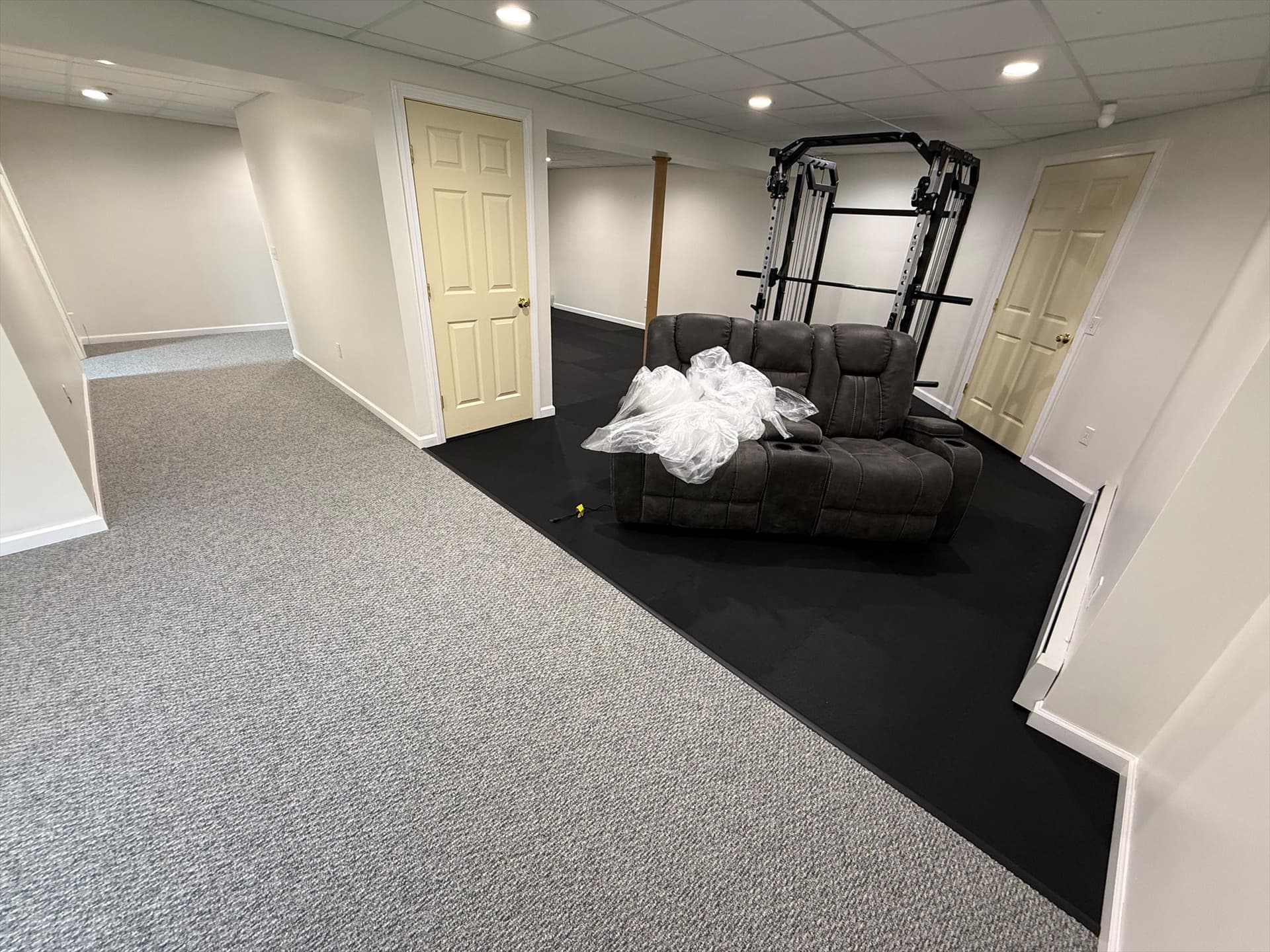
A Floors Now project in Colchester
In this August 2026 basement project, Madoc Coracle carpet finished the planned carpeted areas and two staircases. Advanced Edge Sports Flooring AE400 interlocking rubber tiles in Back in Black defined the home-gym area.
The rubber tiles were interlocked without adhesive over the older underlayment already in place. That documented installation is one example; your product, substrate, equipment, and room conditions determine the preparation and fastening your floor needs.
Explore the Colchester projectYour rubber flooring project
Share the room, existing flooring, equipment, daily activity, and any moisture, sound, or cleaning concerns. We can help you compare rubber options and plan the next steps. You can also visit our Newington showroom.